
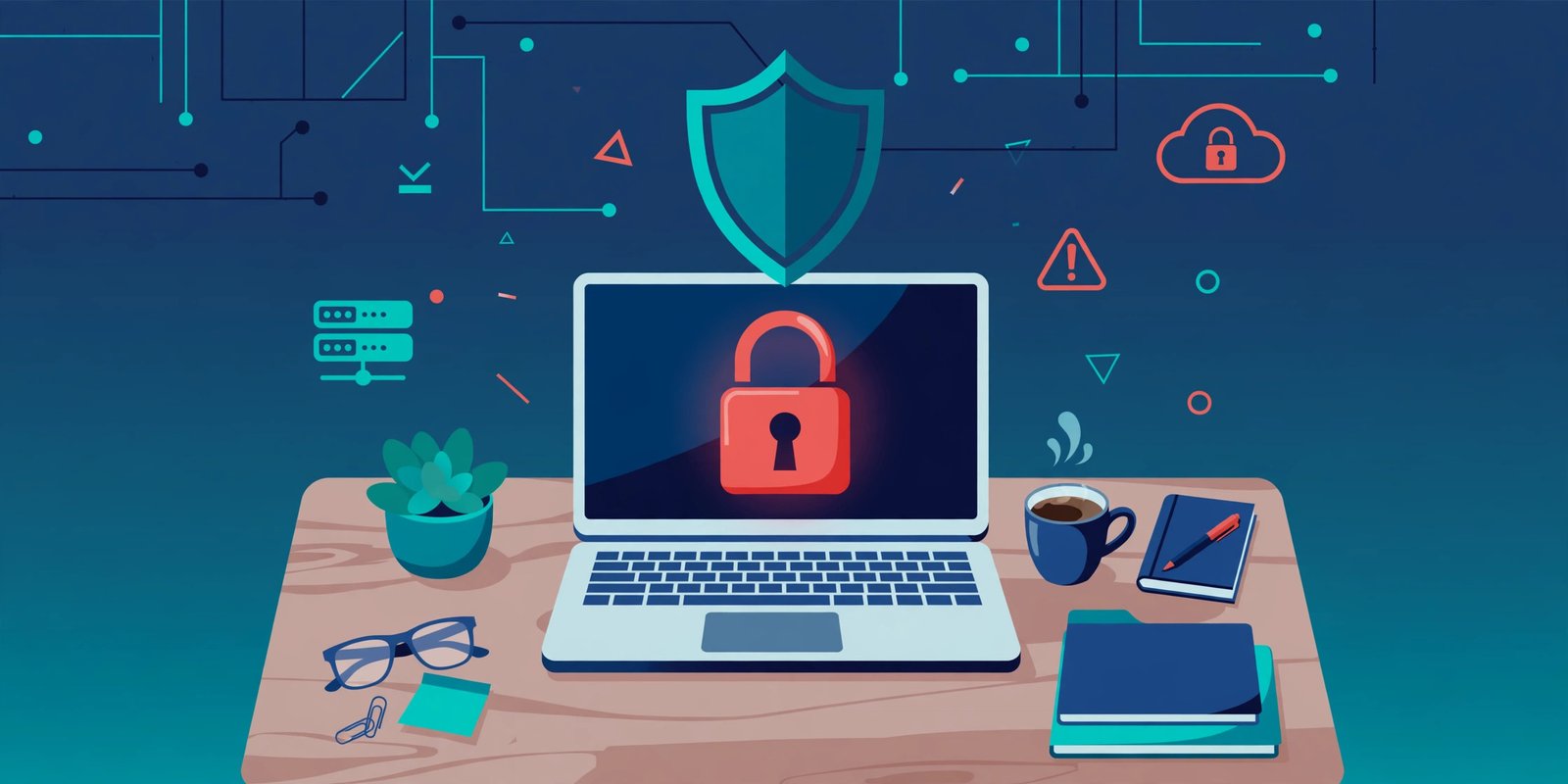
Ransomware is malicious software that locks a small business out of its own files and then demands payment to give them back. It scrambles documents, spreadsheets, customer records and emails so they cannot be opened, and it leaves a ransom note on screen, usually demanding payment in cryptocurrency such as Bitcoin. The National Cyber Security Centre (NCSC) calls ransomware a major threat to the UK, and it warns that attacks are becoming both more frequent and more sophisticated. This guide explains it in plain English: what it does, how it gets in, what happens hour by hour, and what to do if it happens to you.
What Ransomware Does in Plain English
Think of ransomware as a digital padlock fitted to your own filing cabinet by a stranger. The files are still on your computer, but you cannot open them. The attacker holds the only key, and the price of that key is the ransom. Some ransomware also locks the whole screen, so you cannot use the computer at all.
Modern attacks usually do more than lock files. Many gangs now steal a copy of your data before they encrypt it, then threaten to publish it online if you do not pay. This is called double extortion, and it means that even a business with perfect backups faces a second problem: its customer data could end up on the internet. The NCSC explains that during an attack, data may be stolen, deleted or encrypted, and that most ransomware tries to spread to other devices on the network, so a whole organisation can lose access to crucial services at once.
Encryption is the technical word for scrambling. When ransomware encrypts a file, it turns readable text into meaningless code. Only the attacker holds the decryption key that can turn it back. Files encrypted by most ransomware cannot be unlocked by anyone except the attacker, which is why prevention matters far more than cure.
How Ransomware Gets into a Small Business
Ransomware does not appear from nowhere. It follows a deliberate delivery process, and almost every successful attack starts with one of three routes.
1. A phishing email
Phishing is still the most common way in. An employee opens an attachment or clicks a link in an email that looks like an invoice, a delivery notice or a message from a supplier. The attachment installs the ransomware quietly in the background. Our guide on how to spot a phishing email shows the red flags to watch for, including fake HMRC refund messages and supplier bank-detail changes.
2. Remote desktop left open to the internet
Many small firms let staff work from home through remote desktop, which lets a computer be controlled from elsewhere. If that door is left open to the internet with a weak password and no second login step, attackers scan for it and walk straight in. Turning on multi-factor authentication and closing remote access when it is not needed shuts this route down.
3. Unpatched software
Software updates often fix security holes that attackers already know about. When a small firm puts off updates for weeks, those holes stay open. The WannaCry attack that hit the NHS in May 2017 spread through unpatched Windows systems, and it remains the clearest warning of what delayed patching can cost.
Attackers also get in through suppliers. If an IT provider or a software supplier you trust is compromised, the attacker can ride that trusted connection into your systems. This is one reason to ask suppliers what security they use, not just what price they charge.
What Happens Hour by Hour
An attack rarely starts with a ransom note. Here is how a typical incident unfolds for a small firm.
Hour 0, the quiet break-in. An employee clicks a malicious link, or an attacker logs in through an exposed remote desktop account. Nothing looks wrong yet. The attacker explores the network, finds the backups, and notes where the valuable files live.
Hours 1 to 24, the spread. The attacker moves from one computer to another, often using ordinary admin tools that look legitimate. Data is quietly copied out to the attacker’s servers. This is the theft stage, and it is why the ransom demand later includes a threat to publish your files.
Hour 24 or later, the lock. The encryption runs, often overnight or at a weekend when nobody is watching. Staff arrive to locked screens and a ransom note. Phones ring, customers cannot be served, and the business stops. The note gives a deadline, usually a few days, and a payment address.
The days after. Even if the business pays, recovery takes days or weeks. Systems must be rebuilt, files restored from backup, and every computer checked for leftover malware. If the business does not pay, recovery still takes days, but it starts from clean backups instead of from a criminal’s promise.
Why Small Firms Pay, and Why They Should Not
Small firms pay for understandable reasons. The business is closed, customers are waiting, and the ransom looks cheaper than a week of lost trade. The attacker knows this, and the deadline is designed to force a fast decision.
The NCSC is clear: law enforcement does not encourage, endorse or condone paying a ransom. There are three practical reasons. First, payment does not guarantee your files back. Some ransomware is wiper malware in disguise, which destroys files and never had a working key. Second, paying marks your business as a payer, which makes repeat attacks more likely. Third, payment funds organised crime, and it can create legal problems if the recipients are under sanctions.
There is also a hard truth about the maths. The ransom is only part of the cost. Rebuilding systems, restoring data, notifying customers and dealing with regulators cost money whether you pay or not. A business that can restore from backups skips the ransom entirely and starts recovery on its own terms.
The One Defence That Works: Backups
If there is one lesson from every ransomware guide, it is this: a recent offline backup turns a disaster into a bad week. A backup that is connected to your network can be encrypted by the same attack, so at least one copy must be offline or locked away from the network. That is the whole point of the 3-2-1 rule: three copies of your data, on two different types of storage, with one copy off site.
Our guide to how the 3-2-1 backup rule works for a small business walks through a worked example for a five-person firm, with costs and a restore test you can actually run. The restore test is the step most firms skip, and it is the step that matters most. A backup you have never tested is a hope, not a plan.
Backups are the last line of defence, not the only one. The NCSC’s layered approach adds the basics that stop most attacks before they start: keep software updated, use multi-factor authentication on email and remote access, train staff to spot phishing, and limit who has admin rights. None of these is expensive. All of them are cheaper than a ransom.
What to Do If It Happens to You
If you think your business has been hit, act fast and in this order.
1. Disconnect, do not switch off. Unplug the network cable or turn off Wi-Fi on affected computers. This stops the ransomware spreading to other machines. Do not switch computers off unless an expert tells you to, because memory evidence can help investigators.
2. Tell your team and your IT support. Let staff know not to open files or click links on affected machines. Call your IT provider or a cyber incident response firm. If you have cyber insurance, call your insurer the same day, as policies often require prompt notification.
3. Do not pay yet. Get advice before you pay anything. Contact the NCSC and the police first. Paying in a panic is the one decision that cannot be undone.
4. Work out what was taken. If customer or employee personal data was stolen, you may need to report a personal data breach to the Information Commissioner’s Office (ICO) within 72 hours. Keep a written record of what happened and when, because the ICO will ask for it.
5. Restore from backup. Once experts confirm the network is clean, restore from your offline backup. If you clicked a phishing link to get here, our guide on what to do after clicking a phishing link covers the first-hour steps in detail.
Who to Report to in the UK
Report a ransomware attack to the NCSC at report.ncsc.gov.uk. The NCSC also runs a free Early Warning Service that can warn you if vulnerable services or early signs of attack are detected on your network. Report the crime to Action Fraud, the UK’s national fraud and cybercrime reporting centre. If personal data was involved, report the breach to the ICO within 72 hours. If your firm is in a regulated sector, such as finance, your regulator may need to know too.
Real UK cases show the scale. The British Library identified a major ransomware attack in October 2023 that disrupted its services for months. In June 2024, an attack on pathology supplier Synnovis disrupted services across several London hospitals. In 2025, Marks and Spencer disclosed an estimated hit of around 300 million pounds in operating profit after a ransomware attack. Small firms rarely make the news, but the NCSC’s incident data records hundreds of ransomware cases against small businesses each year, with equally severe consequences for the firms involved.
Frequently Asked Questions
Should a small business pay a ransomware demand?
The NCSC advises against paying. Payment does not guarantee your files back, some ransomware cannot be decrypted even after payment, and paying funds further crime and can mark your business as a payer. Restore from a tested offline backup instead, and report the attack to the NCSC and Action Fraud.
How long does recovery from ransomware take?
For a small firm with tested offline backups, recovery usually takes days. Without backups, it can take weeks, because every system must be rebuilt and every file checked. The fastest recoveries come from firms that practised restoring from backup before they needed to.
Will cyber insurance cover a ransomware attack?
Many cyber insurance policies cover ransomware costs, including incident response, legal advice and business interruption, but cover varies widely. Check whether your policy requires multi-factor authentication and offline backups, because insurers may refuse a claim if those basics were missing. Tell your insurer on the day of the attack, not after.
Can antivirus software stop ransomware?
Antivirus and endpoint protection help, but they are not enough on their own. Ransomware often enters through phishing or stolen logins, which antivirus cannot block. Layered defences work best: updated software, multi-factor authentication, staff training, limited admin rights and offline backups together.
Does ransomware only target big companies?
No. Small firms are attractive targets because they hold valuable customer data but often have weaker defences than large companies. Attackers automate their scans, so a five-person firm is as easy to find as a five-thousand-person one. The NCSC says ransomware is a board-level responsibility for businesses of all sizes.
Conclusion
Ransomware is not a technical curiosity. It is a business risk that can close a small firm for days, expose customer data and cost far more than the ransom itself. The good news is that the defences are simple and mostly free: keep software updated, turn on multi-factor authentication, teach staff to spot phishing, and keep a tested offline backup. Do those four things and you have taken away most of what makes a small firm an easy target. Start with the backup today, because it is the one defence that works after everything else has failed.