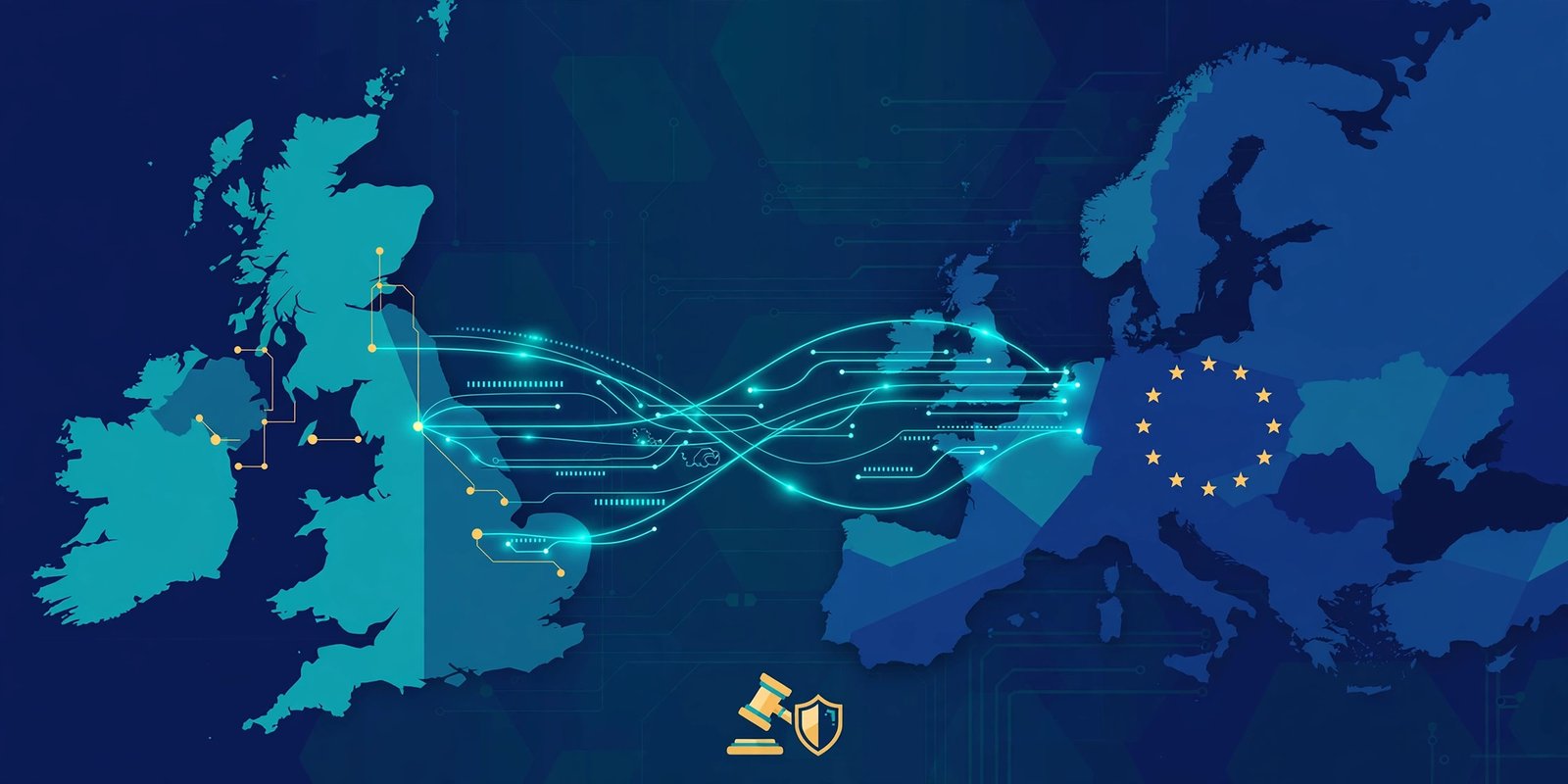
Yes, it can. The EU AI Act can apply to a UK company even though the UK left the EU. If you sell AI into the EU, or the output of your AI system is used in the EU, the Act reaches you. A firm that only serves UK customers, with UK staff and UK decisions, is generally outside it. This article explains the three routes into scope, the dates that matter, the fines, and what to do now.
The short answer, and why Brexit did not end it
The EU AI Act is Regulation (EU) 2024/1689, the first comprehensive AI law in the world. It entered into force on 1 August 2024. It does not apply only to companies based in the EU. Like the GDPR before it, it regulates the EU market and the people in it, not just EU companies.
Article 2 of the Act sets out who it applies to, and several of its limbs are written to reach businesses outside the EU. Brexit did not take UK companies out of the Act. It simply means the Act reaches them from across the border, in the same way the GDPR always has. If you touch EU customers, you play by EU rules for that activity.
That is the point most small firms miss. The test is not where your company is registered. The test is where your AI goes, and where its output is used. A one person business in Manchester can be in scope. A fifty person firm in London can be out of scope. It depends on the system, not the size of the company.
The three ways a UK company comes into scope
There are three main routes by which a UK company falls under the EU AI Act. If any one of them is true for a given AI system, that system is in scope.
1. You place an AI system on the EU market
If you are a provider who places an AI system, or a general purpose AI model, on the EU market, you are in scope wherever you are established. This is Article 2(1)(a). A London software company that sells an AI powered product to a customer in Spain falls under this limb. It does not matter that the company has no EU office, no EU server and no EU employee.
2. The output of your AI system is used in the EU
Providers and deployers outside the EU are in scope where the output produced by their AI system is used in the EU. This is Article 2(1)(c), and it is the route that catches most UK firms by surprise. Your system can stay entirely on UK infrastructure. If it produces analytics, predictions, scores or content that an EU business then uses, the Act applies to that activity.
Take a simple example. A UK agency uses AI to score sales leads for a client in Germany. The scoring happens in the UK, but the output is used in the EU. That system is in scope. The same logic applies to a UK firm that writes AI generated product descriptions for an EU shop, or runs an AI chatbot that answers customers in France.
3. You operate through an EU entity, or you supply AI products into the EU
A deployer established in the EU is in scope under Article 2(1)(b). So if your UK company has an EU subsidiary, branch or office whose staff use AI systems, that part of your business is caught. Importers and distributors who place a third party AI system on the EU market are also in scope, as are product manufacturers who place AI embedded products on the EU market under their own name or trademark.
One caution matters here. Scope is decided per system, not per company. One product you sell can be in scope while another product, used only in the UK, is not. Map your systems one by one. A company wide yes or no answer is usually wrong.
Are you a provider or a deployer? Why the label matters
The Act gives different duties to different roles, so the first job is to work out which one you are for each system.
A provider develops an AI system or a general purpose AI model and supplies it under its own name or trademark. Providers carry the heavier duties. They must run a risk management system, keep technical documentation, check the system against the rules before it goes on the market, and keep records after it is sold.
A deployer uses an AI system under its own authority, for example a small firm that buys an AI recruitment tool or runs an AI chatbot on its website. Deployers must use the system as instructed, keep human oversight in place, monitor how it performs, and tell people when AI is being used in certain situations.
Most small UK firms are deployers, not providers, and that is good news. The duties are lighter. But the label can change. If you white label an AI tool and sell it as your own product, you can become a provider, with provider duties. If you substantially change a system, for example by fine tuning a general purpose model for a specific purpose, you can take on provider duties for that changed system. Check the label before you sign a contract, not after.
What counts as high-risk AI, and what most small firms actually use
The Act sorts AI systems into risk levels, and the level decides how much you must do. Prohibited practices are banned outright. High risk systems face the full set of duties. Limited risk systems face transparency duties. Minimal risk systems, which is most everyday business AI, face almost no duties under the Act itself.
High risk AI includes systems used in recruitment and staff selection, credit scoring, education admissions, law enforcement, medical devices, safety components of products, critical infrastructure, and biometric identification. If your firm uses AI to screen job applicants or to decide who gets a loan, you are in high risk territory and you should get proper advice.
Most small business AI is not high risk. Drafting emails, summarising long documents, answering common customer questions with a chatbot, and writing marketing copy are all low risk uses in most cases. They still need care under UK GDPR and basic good practice, but the heavy EU AI Act duties do not usually apply.
Limited risk systems carry transparency duties. If your customers are talking to a chatbot, they should know it. If content is AI generated, it should be labelled as such. These transparency duties phase in during 2026, so build the habit now rather than retrofitting it later.
Prohibited practices have been banned since 2 February 2025. They include social scoring by public authorities, AI that manipulates people into decisions they would not otherwise make, untargeted scraping of facial images from the internet, and emotion inference at work or in school. A normal small business should never be near these, but it is worth knowing the line exists.
The deadlines that matter
The Act applies in phases, not all at once. These are the dates to put in your diary.
1 August 2024: the Act entered into force.
2 February 2025: the bans on prohibited practices and the AI literacy duty in Article 4 started to apply. Every provider and deployer must make sure staff have a sufficient level of AI literacy for the systems they use.
2 August 2025: duties for general purpose AI models started to apply.
2 August 2026: duties for high risk AI systems are currently due to apply, along with transparency duties for AI generated content. The EU has proposed changes under its Digital Omnibus package that may move some of these dates, so check the current date before you plan around it.
2 August 2027: full application of the Act, including high risk AI embedded in regulated products.
For a small UK firm, the dates that matter most are the ones already in force: the prohibited practices ban and the AI literacy duty. If you use AI at all, your staff should already be trained to use it safely and to spot its limits.
What happens if you ignore it
The fines are large. Breaches of the prohibited practices rules can bring fines of up to 35 million euros or 7 percent of worldwide group turnover, whichever is higher. Breaches of most other duties can bring fines of up to 15 million euros or 3 percent of worldwide turnover. Fines apply at group level, so a parent company cannot hide behind a small subsidiary.
Enforcement sits with market surveillance authorities in each EU member state, coordinated by the EU AI Office. For a small UK firm, the realistic risk is usually not a headline fine. It is losing EU customers. EU buyers increasingly ask suppliers for proof of AI Act compliance before they sign. A firm that cannot answer the question loses the deal to one that can. Treat compliance as a sales asset, not just a legal chore.
What UK law still applies at home
There is no UK AI Act. As of late 2026, the UK has taken a different route: a sector led, principles based approach set out in the government’s 2023 White Paper on AI regulation. There is no single AI regulator and no AI bill before Parliament. Instead, existing regulators apply existing law to AI. The ICO covers data protection, the FCA covers financial services, and the CMA covers consumer protection.
That does not mean UK firms are unregulated at home. UK GDPR and the Data Protection Act 2018 still apply to all personal data processing, including AI driven processing. The Data (Use and Access) Act 2025 also changed some rules on automated decision making. If your AI handles customer data, the UK GDPR rules on lawful basis, transparency and data minimisation apply in full, and you should read our guide on whether you can put customer data into ChatGPT under UK GDPR before you paste anything into a chatbot.
The practical result is two rulebooks. At home, UK GDPR and sector rules govern your AI use. For EU customers, the EU AI Act sits on top. A firm that sells into both markets must satisfy both, and the stricter rule usually wins for that activity.
What to do now: five steps for a small UK firm
You do not need a law firm to start. Work through these five steps this week, and you will know where you stand.
1. List every AI system you use, sell or supply. Include the obvious ones, like a chatbot on your website, and the hidden ones, like AI features inside your CRM, your accounting software or your recruitment tool. For each one, note where its users sit and where its output is used: UK only, or EU too.
2. Label each system as provider or deployer. If you built it or sell it under your name, you are likely the provider. If you bought it and use it, you are likely the deployer. Note any system you have fine tuned or rebranded, because that can change the label.
3. Check for high risk uses. Recruitment, credit decisions, education, medical devices and safety critical uses are the ones to flag. If none of your systems touches these areas, your EU AI Act duties are probably light, and transparency and record keeping will cover most of it.
4. Appoint an authorised representative if you need one. If you are a non EU provider of a high risk AI system or a general purpose AI model placed on the EU market, you must appoint an authorised representative established in the EU, by written mandate, before you make it available there. This is a formal step, so take advice if it applies to you.
5. Train your staff and write a short policy. The AI literacy duty has applied since February 2025, so train everyone who uses AI on what it can and cannot do, and on what data they must never paste into it. Write a short AI use policy that staff can actually follow. Our AI usage policy template for UK small businesses gives you a starting point. Tighten the basics at the same time: shared logins and weak passwords undo every other control, so a password manager for your small team is a cheap first fix.
Frequently asked questions
Does the EU AI Act apply if I only use ChatGPT for my UK business?
Generally no, if the use is internal and everything stays in the UK: UK staff, UK customers, UK decisions. But if the output of that AI use goes to EU clients, for example reports, scores or content delivered to a customer in the EU, that activity can be in scope. Check where the output goes, not just where the typing happens.
I have no EU office. Am I safe?
No. Having no EU establishment does not take you out of scope. The Act reaches you through the market you sell into and the output you produce, not through an office address. Many UK firms with no EU presence at all are in scope because they sell AI products or AI generated output to EU customers.
What is an authorised representative?
An authorised representative is a person or company established in the EU whom a non EU provider appoints by written mandate to act on its behalf for EU AI Act purposes. It is required before a non EU provider places a high risk AI system or a general purpose AI model on the EU market. The representative holds documentation and deals with EU authorities on the provider’s behalf.
Does the Act apply to free AI tools?
Yes, it can. The test is use and market, not price. A free AI tool used to produce output for EU customers is treated the same way as a paid one. Free does not mean exempt.
Should I stop selling to the EU to avoid the Act?
For most small firms, no. The Act sounds daunting, but most everyday business AI is low risk, and the duties for low risk systems are modest: transparency, staff training and basic records. Stopping EU sales would cost far more than a short compliance checklist. If you do have high risk uses, get advice early, but do not panic and do not quit the market.
Conclusion
The EU AI Act does apply to UK companies, but only when their AI touches the EU. Sell AI into the EU, or produce AI output that is used there, and the Act applies. Serve UK customers only, and it generally does not. Work out which systems touch the EU, label yourself provider or deployer for each one, check for high risk uses, train your staff, and write a short policy. Do that, and a law that looks like a wall becomes a checklist. And if your exposure to the EU is significant, or you use AI in recruitment, credit or safety critical work, speak to a lawyer who specialises in it. This article is general information, not legal advice.


