
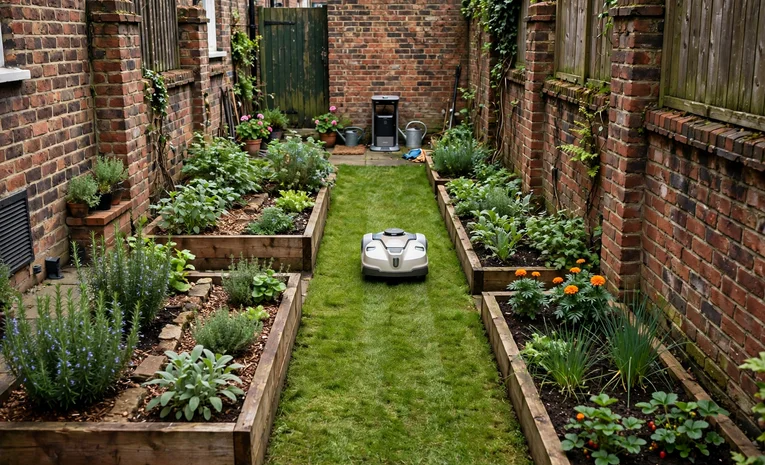
Direct answer: For a small UK garden of up to about 300 m², choose a compact robot mower rated comfortably above the measured grass area. Prioritise reliable boundary detection, narrow-passage handling and a charging position that suits the layout. Wire-free is convenient, but only when the garden supports its camera, Wi-Fi or satellite requirements.
Small gardens reward fit, not maximum specification
The best robot lawn mower for a small garden is not automatically the most advanced machine. A compact lawn can expose weaknesses that matter less on an open field: tight turns, raised borders, narrow side passages, furniture, washing lines, play equipment and weak Wi-Fi at the far fence. In this guide, a small garden means up to roughly 300 m² of mowable grass. Measure the lawn itself, excluding paving, beds, sheds and other non-grass areas. Then choose a mower with headroom above that figure. A machine operating near its absolute capacity may need longer schedules and offer less flexibility during fast spring growth.
Six features that matter most at small scale
1. Compact body and turning behaviour
A smaller chassis is easier to route between borders and around obstacles. Turning behaviour matters as much as body width because repeated pivoting can mark damp ground. Look for planned navigation or a pattern that does not overwork the same corners.
2. Narrow-passage support
Measure the tightest grass route between zones. Some wired machines specify the minimum distance between boundary wires. The Bosch Indego XS 300, for example, is described as handling corridors down to 75 cm between wires. That figure is about installation spacing, not the mower’s actual width.
3. A modest cutting width
A cutting width around 19 cm can suit compact spaces because the mower can manoeuvre without a wide deck. A narrow deck may take longer, but time is less important when the machine runs automatically and the lawn area is small.
4. Appropriate navigation
Boundary wire offers a clear physical limit. Camera-led systems can avoid trenching. RTK and GPS systems create editable virtual boundaries, but need an adequate view of the sky and careful base placement. Whichever you choose, you still need to assess the garden properly.
5. Multi-zone control
Two grass areas connected by a narrow route may need scheduled zones or a defined channel. If there is a step, locked gate or gravel break, ask whether the mower can travel between areas. Carrying it manually weakens the convenience case.
6. Edge behaviour
Terms like “edge cutting” sound promising, but they don’t guarantee a neat finish along every wall. A wheel often needs firm ground beyond the blade disc. Border design can determine how much manual trimming remains.
Three model examples for the shortlist
These are examples drawn from current market coverage and published specifications. They are not test-based rankings, and specifications should be checked with the manufacturer or retailer before purchase.
| Example | Reported fit | Why consider it |
|---|---|---|
| Bosch Indego XS 300 | Up to 300 m² | Wired, planned cutting, 75 cm passages |
| Worx Landroid Vision WR202E | Up to 250 m² | Vision-led, compact capacity |
| Mammotion YUKA mini | Models around 800–1,000 m² | Compact design, wire-free options |
Bosch Indego XS 300
The Indego XS 300 is a useful example of a mower designed around genuinely small lawns. Its published capacity is up to 300 m², and its LogiCut system maps the lawn rather than relying entirely on random movement. Published product information also reports support for up to three lawn areas within the combined capacity. Its boundary wire is both strength and compromise. Once installed accurately, the limit is predictable and does not depend on satellite reception. Installation takes planning, and later changes to beds or lawn edges may mean moving the wire.
Worx Landroid Vision WR202E
The WR202E is marketed for lawns up to 250 m². Its camera-led approach removes the traditional perimeter-wire installation. That can be attractive in a finished garden where digging or pegging wire is undesirable. Vision systems still need visible, unambiguous edges. A lawn merging into low planting, gravel or similar-coloured surfaces may need physical guidance. Check performance under the lighting conditions in which you intend to mow, and confirm how the machine handles paths between zones.
Mammotion YUKA mini series
The YUKA mini range shows how compact design and wire-free navigation are moving into higher-capacity machines. Reported versions cover roughly 800–1,000 m², with a cutting width around 19 cm on some models. That capacity is more than most small lawns need, but the compact format and zone tools may suit a complicated urban garden. Don’t pay for capacity you won’t use, unless the navigation or slope handling solves a real problem in your garden. Also verify whether the model needs an RTK receiver, network RTK service, clear sky view or another positioning arrangement.
Wire or wire-free in a compact garden?
| Your garden | Likely better fit | Reason |
|---|---|---|
| Stable, clear lawn edge | Boundary wire | Predictable, lower-tech limit |
| Frequently changing layout | Wire-free | Editable virtual zones |
| Dense tree or building cover | Wire or vision | Satellite lock may suffer |
| Clear, open sky | RTK/GPS | Good positioning conditions |
| Ambiguous grass borders | Wire or added edging | Clear boundary cue |
In a small garden, installation time can be disproportionate to mowing time. Wire-free technology is valuable when it solves that problem, not merely because it sounds newer. A simple wired mower may be the more dependable purchase when the layout will not change.
Plan the installation before choosing a model
- Measure the grass: use a tape, mapping tool or simple length-by-width sections. Do not count patio and beds.
- Measure every pinch point: record the usable grass width and, for wired models, the likely distance between boundary wires.
- Map obstacles: note trees, raised roots, washing-line bases, ponds, play equipment and low borders.
- Check the charging site: it needs power, firm ground and the clear approach specified by the manufacturer.
- Test connectivity: confirm Wi-Fi or mobile coverage where the dock and lawn sit.
- Assess the sky: RTK and satellite-led systems can struggle near tall buildings or dense tree canopies.
Prepare a small lawn for reliable runs
Clear toys, hoses, branches, fallen fruit and loose edging before mapping or mowing. Small lawns often contain more objects per square metre than large lawns, so preparation has an outsized effect on reliability. Bring long grass down with a conventional mower first. Set the robot to a higher cut and reduce it gradually. Repair holes or soft patches around the charging route because repeated wheel traffic can worsen them. Where possible, create mower-friendly edges with level paving that supports a wheel beyond the grass. This can reduce the uncut strip near beds. It will not eliminate every touch-up, but it can make the routine faster.
Costs and value for a small lawn
Small-garden robot mowers cover a wide price range. Compare the complete package: mower, charging station, boundary components or positioning hardware, replacement blades, warranty and local repair support. Do not treat an app or a high capacity rating as value unless it solves a need. A small lawn may take only minutes to cut manually, so the financial case is weaker than it is for a larger garden. It’s worth it when convenience, less physical effort, or a consistently tidy lawn matters to you. Read the broader guide on whether a robot mower is worth it before focusing on features.
Common buying mistakes
- Buying exactly to measured capacity: leave headroom for growth, weather interruptions and future layout changes.
- Ignoring the narrowest route: the mower must reach the lawn, not merely fit on it.
- Assuming wire-free means condition-free: cameras and positioning systems still have environmental requirements.
- Expecting perfect borders: most small gardens retain some manual edge work.
- Choosing from specifications alone: return policy, spare parts and support matter over several seasons.
Frequently asked questions
What size robot mower do I need for a small garden?
Measure only the grass and choose a rated capacity comfortably above it. For a 200 m² lawn, a model rated above 200 m² provides useful scheduling headroom.
Wire or wire-free for a small garden?
Wire is predictable for a stable layout. Wire-free is easier to alter, but only if the garden supports the camera or positioning system.
Can a robot mower handle narrow passages?
Some can. Compare the maker’s minimum corridor specification with your measured route. For wired models, note whether the figure is stated between boundary wires.
Are robot mowers overkill for a small lawn?
They can be. If manual mowing takes only a few minutes, the decision is mainly about convenience or physical effort rather than financial return.
Will it mow right to a wall?
Usually not completely. The blade disc sits inside the body, so a narrow strip may remain where a wheel cannot pass beyond the grass edge.
Does a wire-free mower need Wi-Fi?
Requirements vary. Some features may rely on Wi-Fi, mobile data, an RTK station or a cloud connection. Check the exact model and the signal in your garden.
Conclusion
For a small garden, the best robot mower is the one that can navigate the actual layout with minimal intervention. Measure first, match the boundary technology to local conditions, and pay for useful fit rather than unused capacity.