
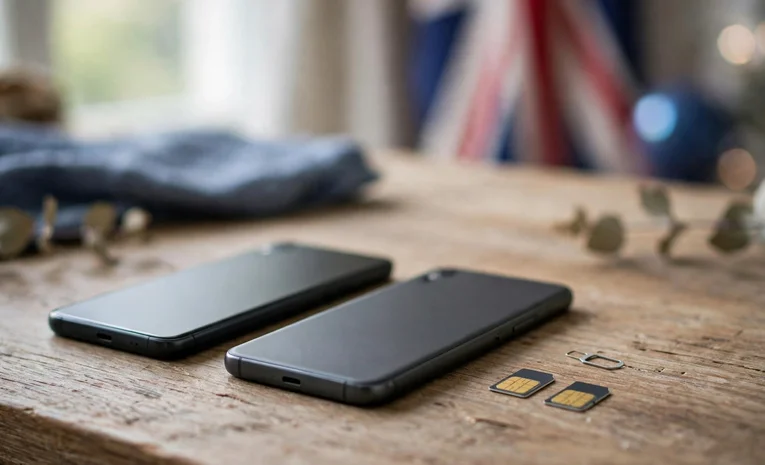
Direct answer: The best dual SIM phones for UK buyers in 2026 are models sold as UK variants with either two nano-SIM slots or nano-SIM plus eSIM. Samsung’s Galaxy A-series and S-series, Google’s Pixel line and recent iPhones all qualify. All four major UK networks (EE, O2, Vodafone and Three) support eSIM, so a nano-SIM + eSIM phone covers work, personal and travel use on one device. Always verify the exact UK model number before buying, because SIM configurations vary by region.
What “dual SIM” actually means in 2026
“Dual SIM” is not one thing. Modern phones implement two-number support in three different ways, and the difference matters when you buy:
| Setup | How it works | Best for |
|---|---|---|
| Two physical nano-SIMs | Two SIM trays (sometimes shared with microSD) | Travellers who swap local SIMs; people who distrust eSIM |
| Nano-SIM + eSIM | One physical SIM plus one or more downloadable eSIM profiles | Most UK buyers: work + personal, or UK SIM + travel eSIM |
| Dual eSIM | Two active eSIM profiles, no physical SIM needed | iPhone 16 and newer, Galaxy S25, Pixel 9 and similar flagships |
For most people, nano-SIM + eSIM is the sweet spot: keep your main UK number on the physical SIM and add a second line (a work number or a travel eSIM) digitally. Dual eSIM goes further but usually means giving up the physical tray entirely, which can complicate things in countries that still require physical SIM registration.
Why UK buyers want two numbers on one phone
Work and personal separation: carry a business line and a private number without carrying two handsets. Travel: keep your UK SIM active for calls and texts while a travel eSIM handles data abroad, far cheaper than roaming. Coverage backup: Ofcom data consistently shows no single network covers everywhere, so a second SIM on a different network fills the gaps. Deals: mix a cheap data-heavy SIM with a second line for calls, or keep a legacy number alive on PAYG while your main contract does the heavy lifting.
Six examples worth shortlisting
These are examples drawn from current UK market coverage and published specifications, not test-based rankings. Specifications and prices change, so confirm the exact UK model number and SIM configuration with the retailer before buying.
| Example | SIM setup (UK model) | Why consider it |
|---|---|---|
| Samsung Galaxy A56 5G | Dual nano-SIM + eSIM (varies by SKU) | Best all-round mid-range pick for work + personal |
| Samsung Galaxy S24 / S25 | Nano-SIM + eSIM; S25 adds dual eSIM | Flagship cameras and long software support |
| Google Pixel 9 / 10 | Nano-SIM + eSIM, dual eSIM capable | Clean software, superb cameras, easy eSIM setup |
| Motorola Moto G86 5G | Dual SIM (physical) | Strong value with big battery |
| OnePlus Nord 5 | Dual nano-SIM | Performance per pound for multitaskers |
| iPhone 16 / 17 | Nano-SIM + eSIM (UK models) | Dual eSIM support; seamless for Apple users |
Samsung Galaxy A56 5G
The A56 is the sensible default for most dual SIM buyers: a large AMOLED display, dependable cameras, 5G on UK bands and Samsung’s multi-year update promise. UK models usually offer flexible SIM options, but the exact setup varies by model number, so check the retailer’s spec sheet instead of assuming.
Samsung Galaxy S24 / S25
If you want flagship cameras and the longest support window, the S-series delivers. The S25 adds dual eSIM capability, which suits buyers ready to go fully digital with two lines. Both handle UK 5G bands well and work with eSIM on all four major networks.
Google Pixel 9 / 10
Pixels are among the easiest phones for eSIM: setup is guided, dual eSIM works, and the cameras remain class-leading. A good fit if your second line is a travel eSIM you will add and remove often.
Motorola Moto G86 5G
Motorola’s G-series keeps winning on value: big batteries, clean-ish software and genuine dual SIM at prices well below flagships. Ideal as a workhorse second device or a first dual SIM phone.
OnePlus Nord 5
The Nord line targets buyers who want speed without flagship prices. Dual nano-SIM suits anyone who prefers two physical cards, for example a UK SIM plus a second country’s SIM for frequent travel.
iPhone 16 / 17
UK iPhones keep the nano-SIM tray alongside eSIM (unlike US models, which are eSIM-only), and support two active eSIMs. If you live in Apple’s ecosystem and want work + personal lines, this is the frictionless option, with the usual Apple price premium.
What to check before buying in the UK
- Confirm the UK model number: specs copied from an Indian, Chinese or US variant can mislead. SIM slots, 5G bands and even eSIM support differ by region. Buy the UK/EU SKU.
- Check 5G and 4G bands: grey imports may miss UK bands (notably band 20 for rural 4G). If the listing says “international version”, verify band support for EE, O2, Vodafone and Three.
- Decide physical vs eSIM: if you regularly visit countries requiring physical SIM registration, keep at least one nano-SIM slot.
- Confirm eSIM on your plan: all four major UK networks offer eSIM, but availability can depend on the plan type. EE, for example, does not offer eSIM on pay-as-you-go. Check before you commit.
- Warranty and returns: UK-bought phones carry UK consumer rights. Marketplace imports might not, and sending back a faulty grey import is a headache.
eSIM on UK networks: the short version
EE, O2, Vodafone and Three all support eSIM, and most of their MVNOs (giffgaff, SMARTY, VOXI, Lebara, Lycamobile) do too. The practical differences are in the details: whether you can order or convert to eSIM online, whether PAYG is supported, and whether you need an app or a store visit. Vodafone and Three are the most straightforward for online eSIM ordering; O2 pay-as-you-go eSIM needs a store visit with photo ID. If you want a second line purely for travel, a travel eSIM from a specialist provider is often simpler than a second UK contract.
Frequently asked questions
Do all UK networks support eSIM?
Yes. EE, O2, Vodafone and Three all offer eSIM, and most MVNOs running on their networks do too. Support can vary by plan type, so confirm eSIM is available on the specific tariff you want.
Can I use two physical SIMs and an eSIM at the same time?
Usually only two lines are active at once, even if the phone stores more eSIM profiles. Check the manufacturer’s specification for the exact combination your model supports.
Will a dual SIM phone bought abroad work in the UK?
Often yes for calls and 4G, but verify UK 5G/4G band support and the exact SIM configuration first. Regional variants differ, and some lack band 20, which matters for rural coverage.
Does dual SIM drain the battery faster?
Slightly. The phone maintains two network registrations. In practice the difference is small on modern phones, and much smaller than the drain from a weak signal on either line.
Can I run two WhatsApp accounts, one per SIM?
Yes. Most Android phones offer a dual-apps or dual-messenger feature that clones WhatsApp for the second number. On iPhone, WhatsApp Business serves as the second instance.
Is eSIM secure for a work number?
An eSIM cannot be physically removed or swapped by a thief, which removes one classic attack route. Standard advice still applies: use a strong device passcode and keep software updated.
Conclusion
For most UK buyers, a nano-SIM + eSIM phone bought as a UK model is the best dual SIM choice in 2026: one physical SIM for your main number, eSIM for work or travel, all four networks supported. Verify the exact SKU, match the setup to how you actually use two numbers, and buy UK stock for warranty peace of mind.