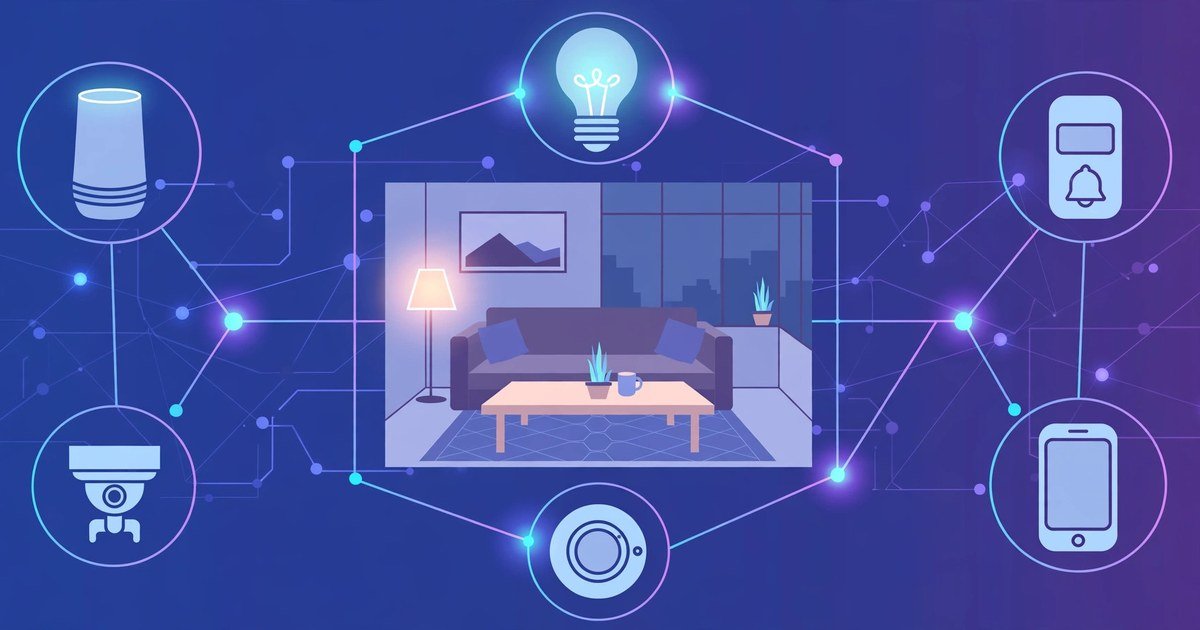
Matter is an open smart home standard that lets gadgets from different brands work together. It launched in October 2022 and is run by the Connectivity Standards Alliance, with members including Apple, Google, Amazon and Samsung. For UK buyers, a Matter badge on the box means wider compatibility across the major platforms.
The problem Matter solves
If you have ever set up a smart home, you know the frustration. One app controls the bulbs. Another controls the plug. The doorbell only talks to one voice assistant. The thermostat talks to another. Nothing works together, and every brand wants you locked into its own ecosystem.
That mess is why Matter exists. The Connectivity Standards Alliance created one common language for smart home devices. A Matter-certified bulb can be controlled from Apple Home, Google Home, Alexa or SmartThings, whichever you prefer. You are no longer punished for mixing brands.
What the Matter logo on the box means
The Matter logo shows three interlocking arrows in a rounded triangle. When you see it on a box, it means the device has passed certification testing by the Alliance. Certification checks that the device speaks Matter correctly. It does not test every feature.
That detail matters. A Matter-certified device might still offer extra features only inside the manufacturer’s own app. The logo guarantees basic control works across platforms. It does not guarantee the fancy extras will.
Practical tip: look for the logo, then check the small print for which features are Matter-controlled and which need the brand’s app. If you are starting your smart home with the front door, our guide to smart video doorbells that need no subscription shows which models fit this approach.
Matter vs Zigbee vs Thread vs Z-Wave
Zigbee
Zigbee is a low-power wireless mesh protocol that powered an earlier generation of smart home devices, including many Philips Hue bulbs. It is a complete ecosystem with its own hubs. Matter devices cannot talk to Zigbee devices directly. Some hubs, including newer Hue bridges, translate between the two.
Thread
Thread is a low-power wireless mesh protocol based on IPv6. Devices pass messages for each other, so the network stays strong even at the edges of your home. No single hub is a point of failure. Thread is not a rival to Matter. Matter uses Thread as one of its main transports, alongside Wi-Fi and Ethernet.
Z-Wave
Z-Wave runs on sub-GHz radio frequencies (868 MHz in the UK and Europe) instead of the crowded 2.4 GHz band. It is popular in security-focused setups but plays a smaller role in the UK consumer market today. Matter does not speak Z-Wave either. Bridges can connect the two.
So what is Matter exactly?
Matter is the application layer that sits on top. It is the shared language, while Thread, Wi-Fi and Ethernet are the roads the language travels on. Bluetooth Low Energy handles the initial setup of new devices. If an analogy helps, think of Matter as the words and Thread as the wires.
Which hub or controller you need
Matter needs a Matter controller, the always-on device that runs your Matter network. A Matter controller is a smart speaker, display or streaming box from one of the major platforms. Common examples include a HomePod mini or Apple TV 4K, a Google Nest Hub, or a fourth-generation Amazon Echo.
If you also buy Thread devices, that same hub needs to be a Thread border router, the device that joins the Thread mesh to your Wi-Fi network. Many current Matter controllers do both jobs, but check the box before you buy.
What works today and what does not
Supported now:
- Lights, plugs, switches and dimmers: full support, the most reliable category
- Door locks and contact sensors: widely supported
- Thermostats, radiator valves and blinds: supported, including room-by-room control
- Robot vacuums: added in Matter version 1.2 (see our robot vacuum buying guide for the UK)
- Energy management and EV chargers: added in version 1.3
- Heat pumps and solar panels: added in version 1.4
Still missing or limited:
- Cameras: Matter does not cover security cameras yet, a notable gap
- Advanced features: brand-specific extras, like detailed energy reports, often need the maker’s app
- Firmware updates: these usually still come through the manufacturer’s app, not your platform app
Should you wait before buying
Do not rip out working gear to chase Matter. If your current devices work, keep them. When you buy something new, treat a Matter badge as a strong tiebreaker. It protects you if you switch platforms later, and it costs little extra in most product lines.
Before you buy, check three things. First, that your home already has a Matter controller you are happy with. Second, that the exact features you want are covered by Matter on that device, not hidden in the brand’s app. Third, that your Wi-Fi or Thread coverage reaches the spot where the device will live. For the wider picture, see our guide to how smart home technology is developing.
Frequently asked questions
Do my old devices get Matter?
Some do, through manufacturer firmware updates. Philips Hue added Matter support to its bridge, for example. Most older devices never will. Check the maker’s support page before assuming.
Does Matter work without the internet?
Basic control does. Matter runs on your local network, so lights and plugs respond even when your broadband is down. Remote access from outside the home and voice assistant features still need an internet connection.
Is it worth paying extra for Matter?
Usually you do not pay much extra. Matter support is becoming standard on mid-range smart home gear. Choose the device that fits your needs and budget first, then prefer the Matter version as a tiebreaker.
Conclusion
Matter is the first serious attempt to end the smart home compatibility war. It is not perfect yet, and cameras are still waiting for support, but the direction is clear. For UK buyers in 2026, the smart move is simple: keep what works, and buy Matter when you buy new.