
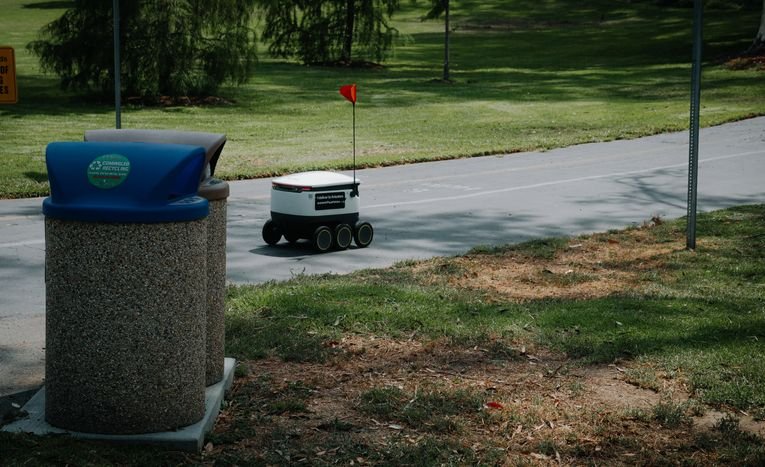
Delivery robots operating on UK pavements currently sit in a genuine legal grey area. Small, low-speed autonomous devices already deliver takeaways and groceries in several English cities, but there is no specific UK law defining what these machines are or explicitly permitting their use on pavements. The government has signalled it intends to change this, but as things stand, the robots already on the streets are operating without a clear statutory basis, a situation that has drawn strong criticism from pedestrian safety campaigners.
This is a fast-moving policy area, with delivery robots already active in cities including Sheffield, Leeds, Cambridge, Bristol, and Milton Keynes, expanding faster than the law has kept pace with. This guide explains the current legal position, what a proposed law change would mean, and the arguments on both sides of an increasingly live debate.
The Current Legal Position
The core legal obstacle dates back to the Highways Act 1835, which prohibits driving a “carriage” on a footway, but the Act obviously predates any concept of an autonomous delivery device and has never been updated to explicitly address them. Whether a delivery robot legally counts as a carriage under this centuries-old provision has never actually been tested in court. The Road Traffic Act 1988, which governs mechanically propelled vehicles, adds a further layer of legal uncertainty, since it was likewise never designed with pavement robots in mind. In practice, this means operators have been running delivery robots through local arrangements and informal trials rather than under any national regulatory framework, and in at least one reported case, without prior notification to the relevant local authority at all.
What a New Law Would Change
| Aspect | Current Position | Proposed Change |
|---|---|---|
| Legal status | Undefined, operating in a grey area | New “Low-speed Zero Emission Vehicle” category |
| Regulatory oversight | Informal local trials, no national rules | Formal national regulation |
| Local authority involvement | Inconsistent, sometimes no notification given | Expected to be part of a formal approval process |
| Pedestrian safety requirements | No statutory requirement specific to delivery robots | To be defined through public consultation |
The government has linked this reform to a broader micromobility package that also covers e-scooters, rather than treating delivery robots as a standalone issue, with ministers indicating that any legal change will follow a public consultation process.
The Case for Legalising Delivery Robots
- Last-mile delivery efficiency: Retailers and takeaway operators see delivery robots as a lower-cost, lower-emission alternative to short-distance van or bike deliveries.
- Economic and manufacturing potential: At least one major operator has indicated it would consider UK manufacturing investment if the legal position were clarified, alongside projected job creation across the sector.
- Regulatory clarity for existing operators: A formal legal category would replace the current inconsistent patchwork of informal local trials with clear national rules.
The Case Against, and Pedestrian Safety Concerns
- Pavement congestion: Campaigners argue that pavements are already under pressure from parked vehicles, e-scooters, and street furniture, and adding delivery robots increases competition for already limited space.
- Disproportionate impact on vulnerable pedestrians: Wheelchair users, visually impaired pedestrians, and people with prams have been specifically flagged as most affected by robots operating in shared pavement space.
- Unresolved liability questions: Who is responsible when a delivery robot causes an injury or collision remains legally unclear under current frameworks.
- Precedent in other countries: Delivery robots have already faced bans in some North American cities following reports of pedestrian collisions and pavement obstruction.
What This Means for UK Businesses Considering Delivery Robots
- Any business considering delivery robot use should treat the current legal position as genuinely unsettled, not simply under-enforced, given the lack of a tested legal precedent.
- Watch for the outcome of the government’s promised public consultation, since final requirements around insurance, local authority approval, and safety standards are not yet confirmed.
- Consider that any national framework is likely to bundle delivery robots with wider micromobility regulation, meaning e-scooter policy developments may be a useful indicator of the government’s overall approach and timeline.
- Engage with local authorities directly if piloting delivery robots, since inconsistent notification has been a specific point of criticism from pedestrian safety campaigners.
Expert Insight
Transport policy specialists following this issue note that the central tension is not really about the technology itself, but about who pavements are ultimately for. Campaigners argue that legalising delivery robots without strong, specific pedestrian protections risks retroactively legitimising a rollout that has already outpaced proper public consultation, while industry argues that continued legal ambiguity is itself holding back both safety standards and investment. How the government balances these two positions in its consultation will likely shape delivery robot policy in the UK for years to come.
Frequently Asked Questions
Are delivery robots currently legal in the UK?
Their legal status is unresolved rather than clearly legal or illegal; they operate through informal local arrangements without a specific national law defining or permitting their use on pavements.
Which UK cities currently have delivery robots operating?
Cities including Sheffield, Leeds, Barnsley, Cambridge, Bristol, Milton Keynes, Reading, and Sunderland have reported delivery robot activity, with expansion ongoing.
What speed do UK delivery robots typically travel at?
Most operate at around 4mph on pavements, broadly comparable to the speed of a mobility scooter.
When might a new law on delivery robots be introduced?
The government has indicated reform will follow a public consultation, with some reporting suggesting changes could arrive as early as 2027, though this has not been formally confirmed.
Who is liable if a delivery robot injures a pedestrian?
This remains a genuinely unresolved legal question under current UK law, which is one of the specific concerns campaigners have raised ahead of any new regulatory framework.
Final Thoughts
Delivery robots on UK pavements sit at the intersection of genuine innovation and a real, unresolved legal and safety debate, and the coming public consultation is likely to determine how this technology is allowed to develop in Britain. Businesses and pedestrians alike are best served following the consultation process closely, since the eventual rules will directly shape both commercial delivery robot rollout and the day-to-day experience of walking on UK high streets. For our full coverage of robotics in the UK, see the robotics hub, including our guide to industrial robotics and automation for related UK robotics investment context.