
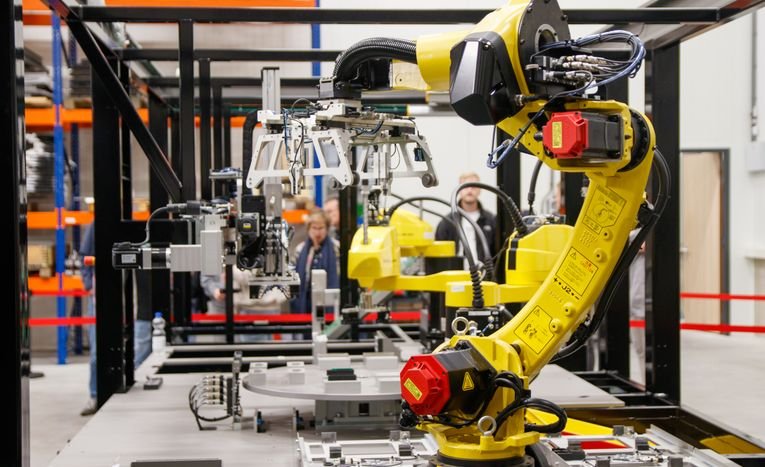
Industrial robots are programmable mechanical arms and automated systems used in manufacturing, warehousing, and logistics to perform repetitive or physically demanding tasks such as welding, palletising, pick and place assembly, and packaging with greater speed, consistency, and precision than manual labour alone. Unlike consumer robots, industrial robots are typically fixed in place or mounted on rails, work within a defined safety zone, and are integrated directly into a production line through programmable logic controllers. For UK manufacturers and warehouse operators, industrial robotics has become central to staying competitive against lower cost overseas production.
Investment in industrial automation has accelerated across UK manufacturing and logistics as businesses face rising labour costs, ongoing skills shortages, and pressure to increase throughput without expanding factory floor space. This guide explains the main categories of industrial robot, how businesses typically justify the investment, and what UK manufacturers should consider before automating a production or warehouse process.
Main Categories of Industrial Robot
- Palletising robots: Stack boxes, bags, or cartons onto pallets in a set pattern, commonly used at the end of a packaging line to prepare goods for despatch.
- Welding robots: Perform spot or arc welding with a consistency that is difficult to match manually, widely used in automotive and metal fabrication.
- Pick and place robots: Use vision systems and grippers to select and move individual items, common in electronics assembly and food packaging.
- Collaborative robots (cobots): Designed to work safely alongside human staff without full safety cages, increasingly used by smaller UK manufacturers for tasks like machine tending.
- AMRs and AGVs: Autonomous mobile robots and automated guided vehicles move materials and finished goods around a warehouse or factory floor without fixed tracks.
Fixed Industrial Robots vs Collaborative Robots
| Feature | Traditional Fixed Robots | Collaborative Robots (Cobots) |
|---|---|---|
| Safety requirement | Fenced cell or light curtain | Force limited, can share workspace with staff |
| Speed | Very high, optimised for volume | Lower, prioritises safe interaction |
| Typical UK investment | £40,000 to £150,000+ per cell | £20,000 to £50,000 per unit |
| Best suited to | High volume, repetitive single tasks | Smaller batch runs, flexible tasks, SMEs |
| Redeployment | Complex, often requires reprogramming and guarding changes | Relatively quick to move and reprogram |
Cobots in particular have opened industrial automation up to smaller UK manufacturers that previously could not justify the cost or floor space of a traditional fenced robot cell, since they can be redeployed across several tasks rather than being fixed to a single process.
Building the Business Case for Industrial Robotics
UK manufacturers evaluating an automation project typically weigh three factors together rather than looking at robot cost in isolation. Labour savings are the most visible, particularly for tasks that are difficult to recruit for or carry manual handling risk. Throughput and consistency gains often matter just as much, since a robot maintains the same cycle time and quality standard across a full shift in a way manual labour cannot always match, especially on repetitive or physically tiring tasks. Finally, payback period, commonly two to four years for a well specified project, determines whether the investment case stacks up against other capital priorities.
Government backed capital allowances and sector specific grants have also made automation projects more attractive for UK SMEs in recent years, and it is worth checking current funding schemes before finalising a project budget.
Common Pitfalls When Automating a Process
- Automating a poorly designed process rather than fixing the underlying workflow first, which simply speeds up an inefficient system.
- Underestimating integration costs, since the robot itself is often a smaller line item than the conveyors, sensors, and software needed to connect it to existing equipment.
- Insufficient staff training, which leads to the robot being underused or incorrectly programmed after initial commissioning.
- Choosing a fixed robot for a task that changes frequently, when a collaborative robot would offer better long term flexibility.
- Overlooking maintenance planning, since unplanned downtime on an automated line can halt an entire production process rather than just one manual station.
Expert Insight
Automation integrators working with UK manufacturers frequently note that the businesses getting the best return are not necessarily those buying the most advanced robots, but those that map and simplify the process before automating it. A well specified cobot on a properly redesigned process often outperforms an expensive fixed robot bolted onto an unchanged, inefficient one.
Frequently Asked Questions
How much does an industrial robot cost in the UK?
Costs vary widely by application, but a basic collaborative robot installation typically starts around £20,000, while a full fenced robot cell for high volume production can run from £40,000 to well over £150,000 once integration is included.
Do industrial robots replace jobs or change them?
Most UK manufacturers report that automation shifts staff toward supervising, programming, and maintaining robotic systems rather than eliminating roles outright, though the mix of skills required does change significantly.
What is the difference between a cobot and a traditional industrial robot?
A cobot is designed with force limiting sensors that allow it to work safely alongside people without a full safety cage, while a traditional industrial robot is generally faster and more powerful but requires guarding to keep staff at a safe distance.
How long does it take to install an industrial robot?
A straightforward cobot deployment can be commissioned in a few weeks, while a complex fenced robot cell integrated into an existing production line can take several months from order to full production.
Is industrial robotics only for large manufacturers?
No. The falling cost and increasing flexibility of collaborative robots has made automation increasingly viable for small and medium sized UK manufacturers, not just large scale producers.
Final Thoughts
Industrial robotics has moved well beyond the large scale automotive plants where it first became common, and is now a realistic option for a much wider range of UK manufacturers and warehouse operators. The businesses seeing the strongest return are consistently the ones that plan the surrounding process carefully rather than treating automation as a simple drop in replacement for manual labour. For a broader look at capital planning around new technology, see our guide to integrating new technology into SMEs. For our full coverage of robotics in the UK, see the robotics hub.