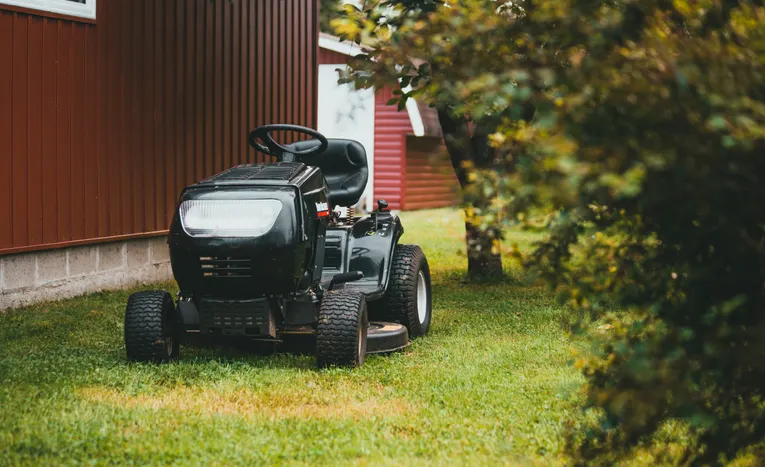
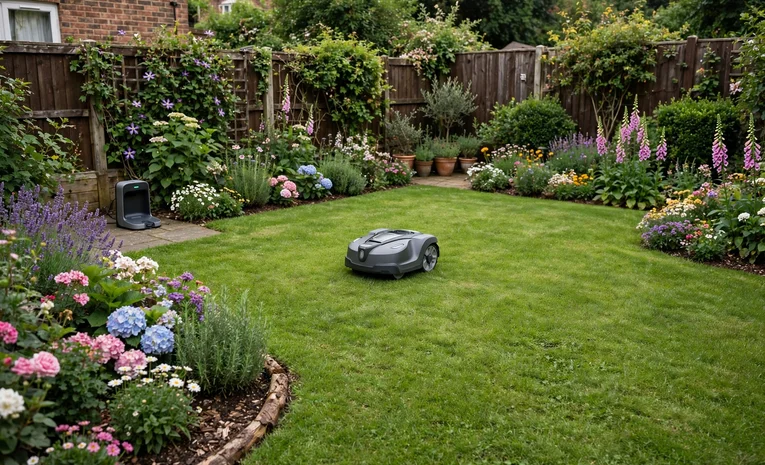
Direct answer: Robot lawn mowers are usually worth considering for open UK lawns of roughly 200–1,500 m² that need cutting every week. They are less convincing for lawns under about 100 m², fragmented gardens, renters or anyone who wants stripes, collected clippings and a completely hands-off lawn-care routine.
The real decision is about garden fit, not novelty
A robot mower replaces frequent cutting, not every lawn-care job. It takes off a small amount of grass on a schedule, returns to its charging station and repeats the process often enough to keep growth controlled. That routine can remove a repetitive weekend task, but only when the machine can move around the whole mowing area reliably. For a simple lawn, regular automated cutting is the main value. For a garden split by steps, gravel, narrow gates and disconnected patches, the owner may still spend time moving the mower, rescuing it or changing the layout. The sensible question is therefore not whether robot mowers work. It is whether a particular mower can work in your particular garden with less effort than your current method.
When a robot mower is likely to be worth it
Your lawn is cut weekly: regular mowing creates a genuine, repeatable time saving. The lawn is reasonably open: fewer obstacles and separate zones mean fewer interventions. You value consistency: frequent trimming keeps the lawn at a steady height rather than allowing a growth-and-cut cycle. Physical effort is a concern: automation reduces pushing, carrying and emptying a conventional mower. Quiet operation matters: many models operate at about 55–60 dB, far quieter than a typical petrol mower.
Owners commonly report saving two to four hours a week during the growing season. Across a UK season, that can amount to roughly 60–80 hours. Treat those figures as reported experience, not a promise: the actual saving depends on lawn size, previous mowing method, growth rate and how often the robot needs help.
When it is probably poor value
A tiny lawn may take less time to cut manually than it takes to clear toys, check the robot and clean it. A push mower can clear about 2,000 square feet in under ten minutes in favourable conditions. At that scale, a robot is primarily a convenience purchase. It is also a weak fit for long grass, rental properties where permanent boundary work is unwelcome, and complex multi-level gardens without connected routes. A robot mower trims maintained grass. It is not a field mower and should not be expected to recover an overgrown lawn in one pass.
Costs: look beyond the price on the box
Decent robot mowers typically start around £700, although the broader market runs from roughly £300 to more than £2,000. A lower price can still suit a small, simple lawn. Higher prices usually buy greater area capacity, more advanced navigation, stronger slope handling, multi-zone management or better support. The initial bill may also include boundary wire, pegs, connectors, a weather cover or professional installation. Wire-free models can reduce physical installation work, but their navigation may depend on cameras, a clear satellite view, an RTK base station or reliable wireless coverage. Check what is included before comparing prices.
Ongoing costs
Electricity use is normally modest because the motors and batteries are small. Replacement blades are a recurring cost and may be needed every few months, depending on mowing frequency, ground debris and blade design. A battery will eventually lose capacity, while damaged boundary wire can require fault-finding and repair. These costs are easier to judge over several seasons. Compare the robot, installation, blades, battery provision and occasional servicing with the value of your own time, a gardener’s fees or the cost of replacing a conventional mower.
What the machine does well
It keeps growth under control
Frequent cutting removes only the tips. The clippings are fine enough to fall back into the sward, where they break down rather than filling a grass box. This mulching approach returns organic material to the lawn, although it does not replace a balanced feeding programme.
It reduces noise and effort
Quiet electric operation makes short scheduled runs less intrusive. Automation also removes the need to push a mower and repeatedly handle a grass box. That can be useful for busy households and people who find conventional mowing physically difficult.
It delivers consistency
A robot does not postpone mowing because the owner is busy. Provided the schedule and cutting height suit the conditions, the lawn stays closer to a chosen height throughout the growing season.
What a robot mower cannot replace
- Long-grass cutting: bring an overgrown lawn down gradually with a suitable conventional machine first.
- Grass collection: robot mowers normally mulch rather than collect.
- Autumn clearing: remove heavy leaves, fallen fruit, twigs and toys before mowing.
- Striping: most models do not create the pronounced stripes produced by a rear roller.
- Renovation: scarifying, aerating, overseeding and feeding remain separate jobs.
- Perfect edges: walls, raised beds and tight corners still need manual trimming, often around 30 minutes a month.
Boundary wire or wire-free?
| Factor | Boundary wire | Wire-free |
|---|---|---|
| Setup | Physical installation | Digital mapping |
| Boundary certainty | Predictable once installed | Depends on sensors/signals |
| Garden changes | Wire may need moving | Map can often be edited |
| Tree cover | Usually unaffected | May challenge RTK/GPS |
| Upfront cost | Often lower | Often higher |
A boundary-wire model suits a stable layout and can be dependable after careful installation. Wire-free navigation is attractive when beds, seating or play zones change regularly. Before buying an RTK or GPS-led mower, assess tree cover and the view of the sky. Vision-led systems avoid satellite dependence but still need clear boundaries and suitable light.
Safety, weather and responsible scheduling
Modern designs commonly use lift and tilt sensors that stop the blades when the chassis is raised or tipped. Sensors reduce risk, but they do not justify leaving children or animals to interact with a working mower. Schedule it for times when the lawn is clear and supervise the first runs. Some models are designed to mow in rain, while others return to the dock when a rain sensor is triggered. Wet mowing may reduce traction, leave soil marks or spread clippings unevenly. Follow the manufacturer’s weather rating and avoid waterlogged ground. Clear branches, cables, small toys and low garden netting before each run. Daytime scheduling is also the more cautious choice for wildlife, particularly when small nocturnal animals may be active.
Winter care protects the battery
Clean the mower at the end of the season, inspect the blades and follow the storage instructions. Bring the battery or complete mower indoors if the manual requires it. Never leave a discharged battery in an unheated shed through winter. Cold storage and deep discharge can shorten useful battery life. Check the charging station, exposed connectors and any visible boundary wire before spring. Start with a higher cutting setting and only reduce it when growth is under control.
A practical value test
- Measure the actual grass area, not the whole property.
- Count separate zones, narrow routes, steps and steep sections.
- Estimate how many hours you currently spend mowing during the season.
- Add installation, blades and eventual battery replacement to the purchase price.
- Decide which manual jobs you are happy to keep doing.
- Choose a model rated comfortably above the measured lawn area.
If the mower can reach every zone, the lawn is regularly maintained and the saved time matters to you, the purchase can be rational. If the lawn is tiny or the garden needs frequent intervention, a light cordless mower may remain the simpler tool.
Frequently asked questions
Do robot mowers work in the rain?
Some do, but capabilities differ. Waterproofing and rain sensors do not make waterlogged ground suitable. Check the model’s instructions and pause mowing when traction or soil damage is a concern.
Are robot mowers safe with pets and children?
Lift, tilt and obstacle sensors improve safety, but supervision and sensible scheduling still matter. Keep people and animals away from the mowing area while the machine is operating.
How long does a robot mower last?
There is no universal lifespan. Chassis quality, weather exposure, maintenance, battery care, spare-parts availability and repair support all affect service life.
Do I still need to trim edges?
Usually, yes. Borders beside walls, fences and raised beds can leave an uncut strip. Plan for periodic trimming even if the main lawn is automated.
Is boundary wire or wire-free better?
Wire is predictable and often cheaper. Wire-free mapping is easier to change, but it relies on the garden providing the conditions required by its navigation system.
Can a robot mower cut long grass?
Not well. Robot mowers are maintenance machines designed for frequent, shallow cuts. Reduce long grass with a suitable mower before starting the automated schedule.
Conclusion
Robot lawn mowers are worth it when they remove a meaningful recurring job without creating a new supervision problem. Match the navigation to the garden, budget for ownership rather than just purchase, and keep realistic expectations about edges, leaves and seasonal lawn care.