Introduction
For most UK gardens, the choice between a boundary wire robot mower and a GPS robot mower comes down to one question: is your garden simple and settled, or open and likely to change. A boundary wire mower is cheaper, proven and dependable on a fixed lawn. A GPS mower costs more, sets up in under an hour and lets you redraw the boundary in an app whenever you redesign a bed. Neither system is better in every garden. The right one is the one that matches your lawn shape, your tree cover and your patience for installation.
The difference is not the mower itself. Both types cut grass with the same small blades, run on the same batteries and follow a schedule you set. The difference is how each one knows where the lawn ends. A wired mower reads a physical cable buried around the edge of the grass. A GPS mower reads satellite signals and follows a virtual boundary you draw on a map. Everything else, accuracy, installation, theft recovery and cost, follows from that one design choice.
How boundary wire works
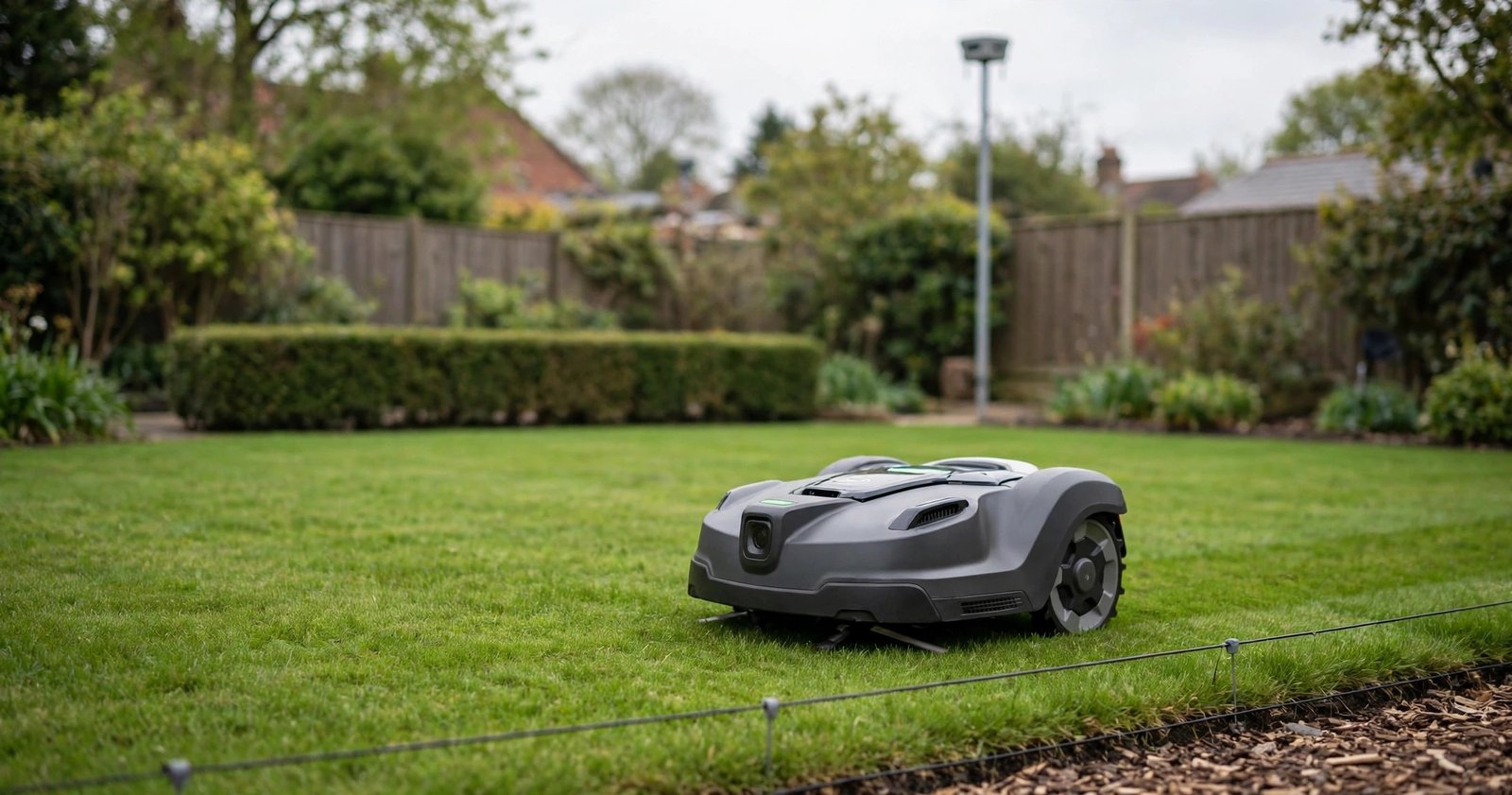
A boundary wire system is the original robot mower design, and it is still the most common one in UK gardens. You lay a thin, low voltage wire around the edge of the lawn, either pegged to the surface or buried a few centimetres deep. The wire forms a closed loop, and it connects to the charging station. A small signal runs through the loop. The mower has a sensor that detects the signal, and it turns back whenever it reaches the edge of the loop.
The wire does more than mark the outside edge. You run it around flower beds, ponds, trees and anything else the mower must avoid, creating islands inside the main loop. You also lay a guide wire across the lawn, a second thin cable that leads the mower back to its charging station and through narrow passages to a second zone. A guide wire is simply a wire that shows the mower the way home when it cannot see the station.
The system is mechanical and predictable. Once the wire is in place, the boundary never moves, never drifts and never depends on a satellite signal or a software update. That is why wire systems still appeal to owners of small, enclosed gardens with a layout that will not change for years. The mower also works in any weather, under trees and between tall fences, because the wire signal is unaffected by the sky above it.
The weakness is change. If you move a border, add a patio or extend the lawn, you must dig up the wire, re-route it and re-peg it. A wire can also break. Spades, aerators, moles and frost can cut it, and a break stops the mower until you find the fault and join the wire again. Finding a break in a long loop can take an afternoon of patient testing.
How GPS navigation works
A GPS robot mower has no perimeter cable at all. Instead, it uses satellite positioning to work out where it is on your lawn, and it follows a virtual boundary you draw in an app. You walk the mower around the lawn once, or you trace the edges on a map, and the mower stores that shape as its mowing area. After that, it mows in neat, planned lines rather than the random pattern older wired mowers use.
Most GPS mowers do not rely on raw satellite signals alone. Ordinary GPS is only accurate to a few metres, which is useless for a lawn edge. They use RTK, which stands for Real-Time Kinematic, a correction system that improves satellite accuracy to within a few centimetres. RTK works through a small reference station placed in your garden, usually on the charging station or a pole, or through a network correction service delivered over the internet. The mower compares the satellite signal with the reference station and corrects its position many times a second.
Some newer models add cameras or LiDAR, which is a laser sensor that scans the surroundings, to help the mower see lawn edges, obstacles and no-go zones. These vision systems matter in gardens where the satellite view is partly blocked, because the camera can keep the mower on the grass when the signal weakens. A hybrid mower that combines RTK with a camera is more forgiving than a pure RTK model in a garden with overhanging trees.
The appeal is obvious. There is nothing to bury, nothing to peg and nothing to break underground. You set the boundary in minutes, and you can change it in seconds. That flexibility is the whole point of GPS mowing, and it is why manufacturers now push wire-free models hard.
Accuracy compared
Accuracy is where the two systems genuinely differ, and the winner depends on your garden.
A boundary wire is accurate in a fixed, old-fashioned way. The mower stops exactly at the wire, every time, in every weather. It never drifts onto a flower bed, because the wire is the limit and the wire does not move. The trade-off is the cutting pattern. Most wired mowers wander in a random pattern, which means they cross the same patch many times and may leave faint strips near the wire. They cover the lawn eventually, but the result can look less tidy than a mower that cuts in straight lines.
A GPS mower with RTK is accurate to within a few centimetres, and it cuts in parallel stripes that look like a professionally mown lawn. That striped finish is one of the most visible differences between the two systems. It also means the mower wastes less time, because it knows exactly where it has been and where it still needs to go.
But GPS accuracy is conditional. It needs a clear view of the sky. Tall buildings, dense tree canopy, a house that blocks one side of the garden and narrow side passages can all weaken the satellite signal. When the signal drops, the mower slows down, pauses or falls back on its camera, and the boundary becomes less reliable. A wired mower has no such condition. It works just as well in a walled courtyard as in an open field.
For a small, enclosed UK garden with tall fences and a big tree, wire is usually the more accurate system in practice, because its accuracy never depends on the sky. For an open lawn with a clear view upward, GPS is more accurate, and the striped finish shows it.
Installation effort compared
Installation is the biggest practical difference between the two systems, and it is the reason many buyers switch to GPS.
Installing a boundary wire takes time and physical work. For a garden of around 500 m², manufacturer and retailer guides typically put the job at four to six hours of labour, including pegging or burying the wire, routing it around beds and testing the loop. Smaller gardens take less time, but the work is still a half day of kneeling on the lawn with a mallet and a spool of cable. You can pay a professional to do it. Professional installation typically adds a few hundred pounds to the bill, and the price rises with garden size and complexity.
GPS installation is much faster. The same guides put a typical GPS setup at 30 to 45 minutes: unbox the mower, place the base station where it has a clear sky view, walk the boundary once with the mower or draw it in the app, and let it map the lawn. There is no digging, no pegging and no cable to test. If you can use a smartphone, you can set up a GPS mower.
That speed has a hidden condition. The base station needs a spot with a good satellite view and a power supply. In a garden hemmed in by a house and tall fences, finding that spot can be awkward, and a poor position means a weak signal for the whole system. A wired system has no such requirement. The charging station just needs power and firm, level ground.
If you hate DIY, GPS wins on installation. If your garden is awkward for satellite signals, the wire installation you dread may still be the more reliable route.
Theft recovery compared
A robot mower is an expensive object that sits in a garden, and theft is a real worry for UK owners. The two systems handle it very differently.
A wired mower is, in practice, tied to its installation. The wire and the charging station stay with the house, and the mower is programmed to work only within that loop. Most wired models have a PIN lock, so a stolen mower cannot be used without the code, but the mower itself is a generic machine. If it is taken, the wire stays behind and the thief can, in principle, reset it. Recovery depends on the PIN, the serial number and, in many cases, your insurance.
A GPS mower has a built-in advantage: it knows where it is. Most GPS models report their live position in the app, so you can see where the mower is at any moment. Some models send an alert if the mower leaves the mapped area or is lifted off the ground. That makes a stolen GPS mower much easier to trace, and much less attractive to steal, because the owner can follow it and the manufacturer can often block it remotely. Our guide to robot lawn mower theft and insurance in the UK (https://techsslash.co.uk/robot-lawn-mower-theft-insurance-uk-guide/) explains PIN locks, tracking and insurance cover in detail.
No system makes a mower theft-proof. A determined thief can take any machine. But GPS tracking is a genuine deterrent, and it is one of the strongest practical arguments for paying the premium. If your garden is visible from the street or backs onto a public path, that deterrent is worth real money.
Cost compared
Cost is where the wire system still wins clearly, and the gap is large enough to decide the purchase for many buyers.
Wired mowers are the cheaper technology. A good wired model for a small to medium garden typically costs a few hundred pounds, and mid-range models sit well under a thousand. The wire, pegs and charging station are included in the box. The only extra cost is installation if you pay someone to lay the wire, which typically adds a few hundred pounds depending on garden size. Replacement wire is cheap, and a break costs little to repair.
GPS mowers cost substantially more. The RTK base station, the satellite receiver and the mapping software all add to the price. Entry-level wire-free models start at around £600, and quality RTK models typically start at £1,500 to £2,500, with premium machines for large gardens costing more. There is no installation bill, but the upfront price is higher, and some models charge for a network RTK correction service on top.
Over a typical ownership period of six to eight years, the gap narrows. A wired mower may need wire repairs, and a professional installation is a one-off cost you never recover. A GPS mower costs more at the start but nothing to install, and you can take it with you if you move house, which a wired installation cannot do. Even so, for a small garden with a fixed layout, the wired mower remains the cheaper option by a clear margin. Pay the GPS premium only when the flexibility, the striped finish or the theft tracking solves a real problem in your garden.
Which suits your garden
The decision is simpler than the marketing suggests. Match the system to the garden, not to the specification sheet.
Choose a boundary wire mower if your garden is small, enclosed and settled. A walled garden, a courtyard, a lawn overshadowed by trees or a house, or a layout with narrow passages between tall fences, all favour wire. Wire is also the right choice if your budget is tight, if you want the cheapest reliable machine, or if you never plan to redesign the lawn. The installation is a one-off chore, and after that the system simply works.
Choose a GPS mower if your garden is open, large or likely to change. An open lawn with a clear view of the sky, a garden with several zones, a layout you redesign every year or a lawn split by paths and beds all favour GPS. GPS is also the better choice if you want the striped finish, if you move house often, or if theft tracking matters because the garden is visible from the street.
If your garden has both problems, dense tree cover and a changing layout, consider a hybrid model that combines RTK with a camera. The camera keeps the mower on the grass when the satellite signal weakens, and the virtual boundary still lets you redraw the map in seconds. Hybrid models cost more, but they are the only wire-free option that works reliably under heavy cover.
Before you buy either system, read our guide to the best robot lawn mowers for small UK gardens (https://techsslash.co.uk/best-robot-lawn-mowers-small-uk-gardens/) to check cutting width, slope rating and noise for your lawn size, and our complete robot lawn mower buying guide (https://techsslash.co.uk/robot-lawn-mowers-uk-complete-buying-guide/) for the full checklist of what to measure before you spend anything.
FAQs
Does GPS work under trees?
It depends on how much sky the mower can see. Light, scattered cover is usually fine, because the RTK correction and the camera can fill in brief signal gaps. Dense, continuous canopy over most of the lawn is a problem. The satellite signal weakens, the mower slows down and the boundary becomes less reliable. If a large tree shades most of your lawn, a wired mower is the safer choice, or pick a hybrid model with a camera that can keep the mower on the grass when the signal drops.
Can I move a wire-free mower between lawns?
Yes, and this is one of the genuine advantages of GPS. A wire-free mower stores several maps, so you can use the same machine on a front lawn and a back lawn, or take it to another property entirely. You select the map in the app and the mower works within that boundary. A wired mower is tied to its installation. Moving it means laying a new wire loop at the second location, which is a half day of work each time.
Which is better for complex garden shapes?
GPS is better for complex shapes, as long as the satellite view is good. You draw the boundary around awkward corners, islands and narrow arms in the app, and the mower follows the map in planned lines. A wired mower can handle complex shapes too, but every island and narrow passage needs wire routed around it, and the random mowing pattern wastes time in corners. If the garden is both complex and heavily shaded, a hybrid RTK plus camera model is the best wire-free option.
Do I need to pay a subscription for a GPS mower?
Some models do, some do not. Mowers with their own RTK base station usually need no subscription, because the correction signal comes from your own hardware. Mowers that use a network correction service, where the correction data comes from the internet, may charge an annual fee for that service. Check this before you buy, because a subscription changes the long-term cost of the mower. The price of the machine is not always the whole price.
Can a boundary wire mower mow in straight lines?
Most wired mowers mow in a random pattern, crossing the lawn in different directions until the whole area is covered. A few newer wired models use a guide wire and a more systematic pattern, but the neat, striped finish is mainly a GPS feature. If the striped look matters to you, GPS is the way to get it. If you only care that the grass is cut evenly, a random pattern mower does the job, it just takes longer and looks less tidy while it works.
Conclusion
Boundary wire and GPS are two different answers to the same question, and neither is the right answer for every garden. Wire is cheaper, proven and dependable in enclosed, shaded or settled gardens, where its fixed boundary never drifts. GPS is faster to install, easier to change and better looking in open, large or evolving gardens, where its virtual boundary and striped finish justify the higher price.
Start with your garden, not the product page. Measure the lawn, look up at the sky, and ask whether the layout will still be the same in three years. A small, walled garden with a big tree wants wire. An open lawn that changes every spring wants GPS. Buy the system that fits the garden you actually have, and the mower will do the rest.