Best Robot Vacuum for Pet Hair in the UK
The best robot vacuum for pet hair in the UK is one with a tangle-free brush roll, suction of at least 5,000 Pa, and a bin or self-empty dock big enough to cope with moulting season. Pet hair is the hardest test for a robot vacuum. It wraps around bristle brushes, fills small bins in a single run, and drifts into corners where round robots cannot reach. This guide explains what actually matters for dog and cat homes, then compares the strongest UK picks for 2026.
A robot vacuum will not replace your main vacuum. It is a daily maintenance cleaner. It keeps hair, dust and crumbs under control between deep cleans. Set that expectation first and you will be happy with the right model. Pick the wrong one and you will spend more time cutting hair off the brush than the robot saves you.
Why pet hair breaks ordinary robot vacuums
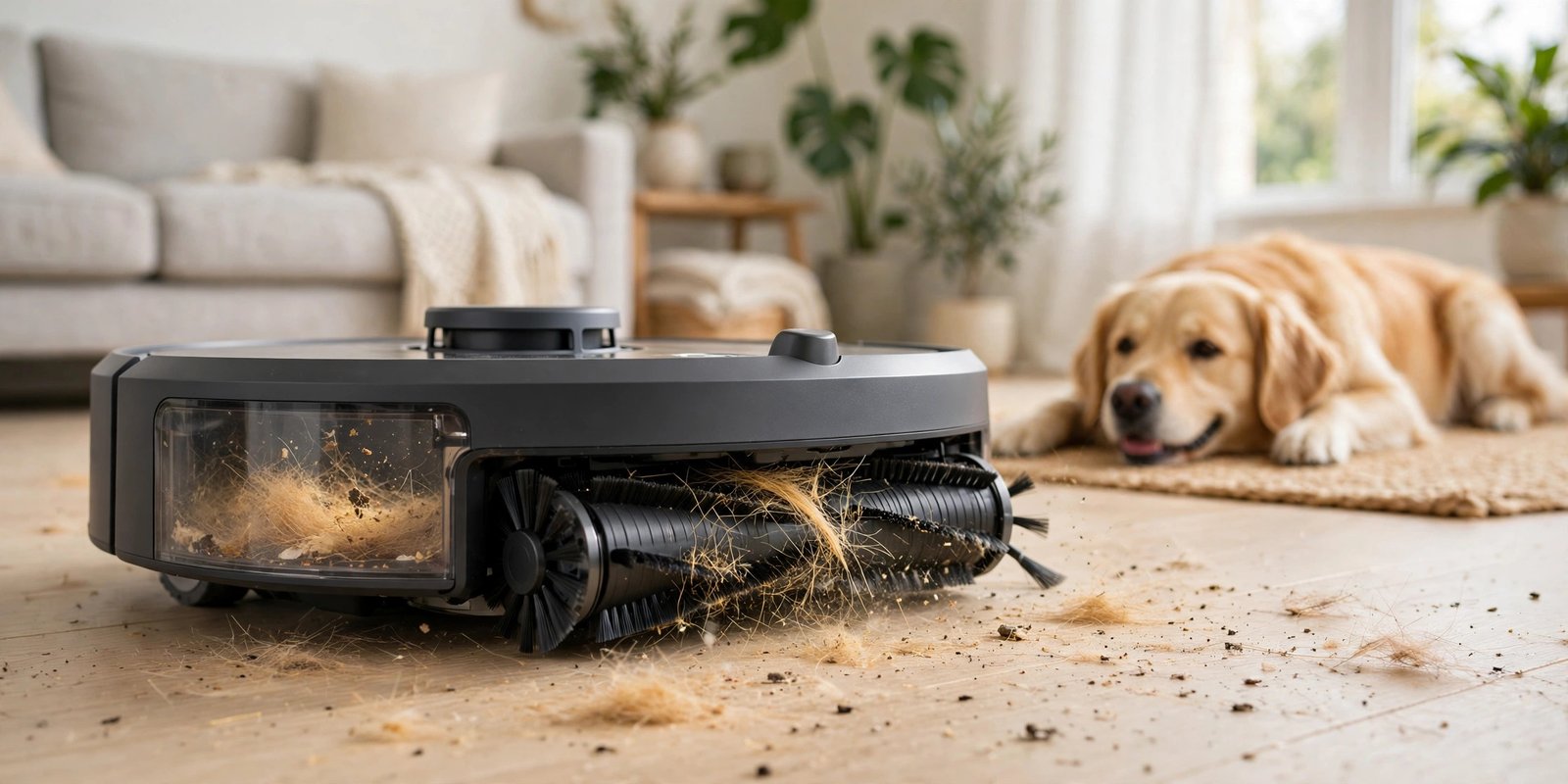
Pet hair is long, light and static. It clings to carpet fibres instead of sitting on top of them. A robot with weak suction pushes it around rather than lifting it. A bristle brush roll grabs it and winds it tight. Within a week, the brush slows down, suction drops, and the robot starts missing patches.
The second problem is volume. A shedding Labrador can fill a 400 ml onboard bin in one room. A cat in moulting season does the same over two rooms. When the bin is full, the robot keeps moving but picks up nothing. That is why bin size matters as much as suction for pet homes.
The third problem is where hair hides. It gathers along skirting boards, under radiators and in the corners of stairs landings. Round robots clean open floors well. They need a good side brush and strong edge suction to reach the places hair collects.
The brush roll test: tangle-free vs bristle
The brush roll is the single most important part for pet owners. Bristle brushes are the old design. They agitate carpet well, but hair winds around every bristle. You end up cutting it free with scissors every few days.
Tangle-free brush rolls use rubber fins or a rubber and comb hybrid instead of bristles. Hair feeds through to the suction path instead of wrapping. UK reviewers consistently report the same result. After weeks of use in homes with cats and dogs, the rubber brush still spins freely while a bristle brush would have needed cleaning twice a week.
Some models go further. The Dreame X50 Ultra Complete uses an anti-tangle main brush that funnels long hair into the suction path. The eufy Omni E25 uses DuoSpiral detangling brushes, two rotating sections that direct hair towards the dustbin. The Tapo RV50 Pro Omni cuts wrapped hair away automatically. Any of these designs beats a plain bristle roll in a pet home.
When you compare models, look for the words rubber, anti-tangle or detangling in the brush description. If a listing only says bristle brush, assume you will be cleaning it by hand. That is the honest rule.
Suction power: how much you actually need
Suction is measured in Pa, short for Pascals. It is a unit of pressure. A higher Pa number means stronger lift from carpet fibres. For pet hair, the number matters most on carpet. Hard floors need far less suction because hair sits on the surface.
UK reviewers suggest 5,000 Pa or above for homes with pets and carpets. The eufy RoboVac L60 offers 5,000 Pa and is widely picked as the budget pet option. The Roborock S8 MaxV Ultra offers 10,000 Pa with dual rubber brushes. The Dreame L40 Ultra offers 11,000 Pa. The Narwal Freo Z10 offers 15,000 Pa. The eufy Omni E25 lists 20,000 Pa.
Do not chase the biggest number alone. A 20,000 Pa robot with a bristle brush will still tangle. A 5,000 Pa robot with a tangle-free rubber roll and a self-empty dock will often clean better day to day. Suction, brush design and bin capacity work together. Judge the three as a set.
Also check how suction changes on carpet. Good models boost suction automatically when they detect carpet. This is called carpet boost. It matters because the robot spends most of its battery on hard floors, then needs full power for the rug.
Bin size and moulting season
Moulting season is the real stress test. Dogs shed heavily in spring and autumn. Cats shed most in spring. During those weeks, a small onboard bin fills before the robot finishes one floor. A self-empty dock solves this. The robot returns to its base, empties itself into a sealed bag, and carries on.
Dock bags hold far more than an onboard bin. The Dreame L40 Ultra dock takes a 3.2 litre dust bag. That means fewer bag changes and less dust escaping back into the room when you empty it. If anyone in the house has allergies, a sealed bag is worth paying for.
If you buy a model without a self-empty dock, check the bin size before you buy. Anything under 400 ml will need emptying after every run in a shedding home. That is fine if you are happy to empty it daily. It is a chore if you bought the robot to save time.
Also check the filter. A washable filter saves money over a year. A sealed HEPA filter traps the fine dust and dander that trigger sneezing. The next section covers that in detail.
HEPA filtration and allergies
HEPA stands for High Efficiency Particulate Air. A HEPA filter traps very fine particles, including pet dander and dust mite waste. For allergy sufferers, it is the difference between a robot that helps and one that stirs dust around the room.
Look for a sealed filtration system, not just a HEPA filter on its own. A sealed system means air passes through the filter before it leaves the robot. If the seals are poor, fine dust escapes through the gaps and the filter does little good.
Run the robot daily during moulting season. Daily runs stop hair building up in carpet fibres, where it is harder to lift. They also keep dander levels lower between deep cleans. A robot that runs every day at a set time does more for allergies than a powerful vacuum used once a week.
Empty the bin or dock bag outside if you can. Pet hair and dander puff back into the air when you tip a full bin into an indoor bin. Do it at the door or in the garden and the job stays done.
Best picks for dog and cat homes
These picks come from UK roundups and hands-on reviews published in 2026, including SmartPicks UK, Modern Robotics, OurPick, GadgetScout and the Ideal Home five star award for the eufy Omni E25. Prices move often, so treat the figures below as a guide at the time of writing. Check the current price before you buy.
Best for pet hair overall: Dreame L40 Ultra, around £750
TechRadar rates the Dreame L40 Ultra as the best robot vacuum for pet hair. Reviewers report it pulled more hair from carpets than any other robot they tested. It offers 11,000 Pa suction, an extending side brush and mop, and a 3.2 litre dock dust bag. The self-emptying system did not clog with hair in testing. The mops lift or stay in the dock when the robot moves onto carpet, so muddy paw prints get cleaned without soaking the rug. This is the pick if your home has plenty of carpet and a heavy shedder.
Best budget pet pick: eufy RoboVac L60, around £349
SmartPicks UK names the eufy RoboVac L60 its best robot vacuum for pet hair. It offers 5,000 Pa suction, laser navigation, an anti-tangle roller and a self-empty station. In testing with a golden retriever and two cats, it picked up visibly more hair than rivals at the same price, and the brush stayed clean after weeks of use. At around £349 with the dock included, it is the smartest choice for pet owners on a budget.
Best for large homes and heavy shedding: Narwal Freo Z10, around £777
The Narwal Freo Z10 leads UK roundups on raw power, with 15,000 Pa suction and a tangle-free brush designed so long hair feeds through rather than wrapping the roller. It has a full self-washing station that washes and dries its own mops. If you want the most suction and the best shot at corralling pet hair without the brush clogging, and you will pay flagship money for it, this is the one.
Best all rounder for pets and hard floors: eufy Omni E25
The eufy Omni E25 was awarded five stars by Ideal Home and later named its best overall robot vacuum. It uses DuoSpiral detangling brushes and 20,000 Pa suction, with a self-cleaning roller that handles muddy paw prints on hard floors. It suits homes with shedding pets, carpets and rugs that need frequent cleaning. It is a strong choice if your floors are mostly hard with some rugs.
Best for dog owners who want hands off cleaning: Tapo RV50 Pro Omni
Smart Bark names the Tapo RV50 Pro Omni its best robot vacuum for dog hair and daily cleaning. It offers 15,000 Pa suction, LiDAR navigation and an anti-tangle brush that cuts wrapped hair away automatically. The self-emptying dock means you are not constantly clearing out a tiny bin. It cleans, empties and mops itself, which suits owners who are out walking the dog while the robot works.
If you only remember one rule from this list, make it this one. Buy the brush first and the suction second. A tangle-free brush with 5,000 Pa will serve a pet home better than a bristle brush with 15,000 Pa.
What to clean weekly to keep it working
A robot vacuum for pet hair needs a weekly routine. Skip it and performance falls off fast. The whole job takes about ten minutes.
First, check the brush roll. Even a tangle-free brush collects some hair at the ends. Pull it off and clear it. Check the side brush too. Hair winds around its base and slows it down.
Second, empty the bin and tap out the filter. If the filter is washable, rinse it and let it dry fully before you put it back. A damp filter clogs and smells. Keep a spare filter so you can swap while one dries.
Third, wipe the sensors and the charging contacts. Pet hair and dust coat the cliff sensors, which stop the robot falling down stairs. Dirty sensors make the robot hesitate or stop. A dry cloth is enough.
Fourth, check the wheels. Hair wraps around the front caster wheel and stops it turning freely. Pull the wheel out, clear the hair, and push it back in. Most models let you do this without tools.
Fifth, wash the mop pads if your model has them. Muddy paw prints leave grit in the pads. Rinse them after each mopping run and replace them when they wear thin. Dirty pads smear instead of cleaning.
Finally, keep the dock area clear. The robot needs space to line up with the dock. Move shoes, toys and pet beds away from the front of the dock. A blocked dock means a failed empty, which means a full bin on the next run.
Pet proofing your robot vacuum routine
Pets and robots need a little planning. Run the robot while the dog is out on a walk if it barks at the noise. Most robots run at 60 to 70 decibels, about the level of normal conversation. Some dogs ignore it. Some never get used to it.
Set no-go zones in the app around food and water bowls. A robot that drags a water bowl across the kitchen makes a mess no suction can fix. Do the same around pet beds during moulting season, or the robot will push a drift of hair across the room instead of collecting it.
Good obstacle avoidance matters more in a pet home than in a child free one. The robot needs to steer around anything a pet leaves behind. LiDAR navigation maps the room and avoids most obstacles. Cheaper bump navigation models will push through. If your pet has accidents, obstacle avoidance is not a luxury. It is essential.
If your robot also mops, check that it lifts its mop on carpet. Models like the Dreame L40 Ultra and the Roborock S8 MaxV Ultra lift their mops when they detect carpet. Without that, the robot drags a damp pad across your rug every run.
Smart home owners can link the robot to their wider setup. Our guide to the Matter smart home standard explains how new devices talk to each other, which helps when you add a robot vacuum to a home that already has smart speakers and lights.
Robot vacuum vs robot lawn mower: the same buying logic
Robot vacuums and robot lawn mowers share the same buying logic. Navigation, running costs and maintenance matter more than the headline specification. Our guide to boundary wire vs GPS robot mowers shows how navigation choices change what a robot can do in a real garden. Indoors, the choice is LiDAR mapping versus bump navigation, and the gap is just as wide.
Running costs follow the same pattern too. Bags, filters, brushes and mop pads are the ongoing cost of a robot vacuum. Our breakdown of the running costs of robot lawn mowers shows how to work out the yearly cost of any robot before you buy it. Do the same maths here: add up a year of bags, filters and brush replacements and compare it with the price of the robot.
Frequently asked questions
Will a robot vacuum scare my cat?
Some cats ignore a robot vacuum from day one. Others hide for the first week and then get used to it. Start with short runs while you are home. Let the cat watch from a high spot. Choose a quiet model and a slow cleaning mode for the first few runs. Most cats settle within a week. If your cat stays stressed, run the robot while the cat is in another room.
Can a robot vacuum handle stairs landings?
A robot vacuum cannot climb stairs, but it can clean a landing if you carry it there. Place it on the landing, start a spot clean, and let it work the flat area. Cliff sensors stop it falling down the stairs. Clean the sensors weekly, because dust on a cliff sensor can make the robot stop and report an error. For the stairs themselves, you still need a handheld or upright vacuum.
How often should I empty a robot vacuum during moulting season?
Empty the onboard bin after every run during moulting season, or buy a model with a self-empty dock. A full bin means the robot moves but picks up nothing. With a dock, check the bag every week and change it when it is full. Most dock bags last two to four weeks in a shedding home.
Is a self-emptying robot vacuum worth it for pet owners?
Yes, for most pet homes. The dock premium pays for itself in time saved and in cleaner air, because the dust stays sealed in a bag instead of puffing out when you empty a small bin. Skip it only if your home is small, your pet sheds lightly, and you are happy to empty the bin after every run.
Does a robot vacuum work on thick carpet with pet hair?
It works as a daily maintenance cleaner, not a deep cleaner. A good model with 5,000 Pa or more and a rubber brush will lift surface hair and dust from thick carpet. It will not reach hair packed deep in the pile. Use your main vacuum for a weekly deep clean and let the robot keep the surface under control between those cleans.
Conclusion
The best robot vacuum for pet hair in the UK is the one whose brush stays clean, whose bin copes with moulting season, and whose suction is strong enough for your carpets. Start with a tangle-free brush roll. Then check suction, bin size and filtration. Then pick the model that fits your home and your budget.
For most pet homes, the eufy RoboVac L60 at around £349 is the sensible buy. For heavy shedders with lots of carpet, the Dreame L40 Ultra at around £750 is worth the step up. Either way, run it daily, clean the brush weekly, and empty the bin before it fills. That routine matters more than any single specification.