Introduction
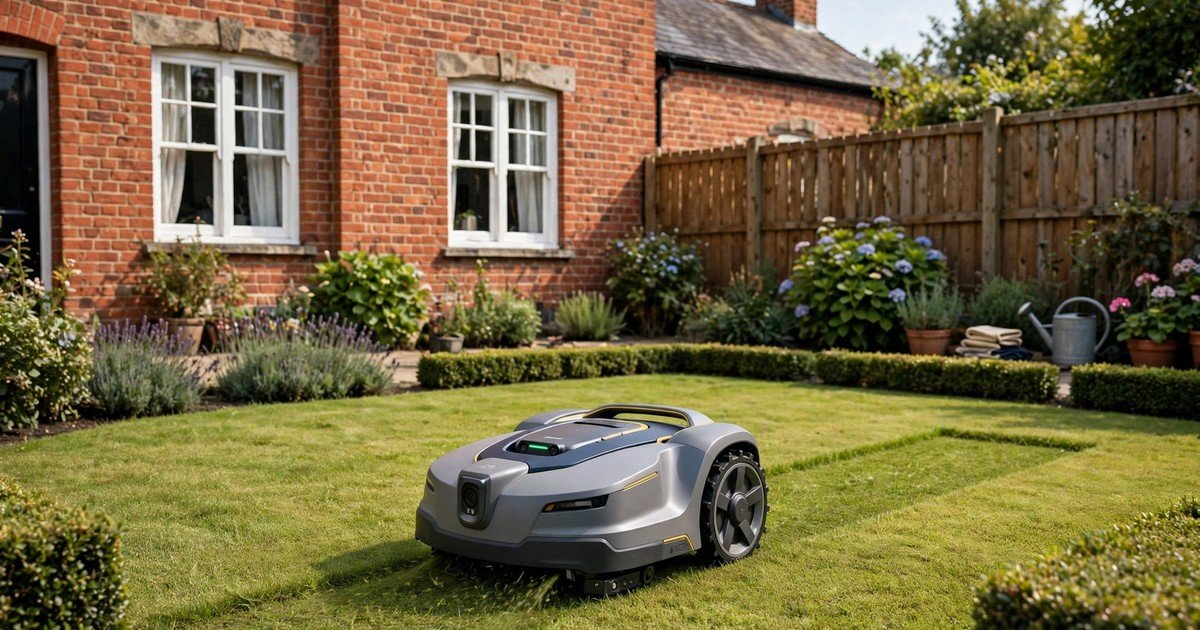
For a small UK garden of up to 200 m², the best robot lawn mower is a compact model rated above your measured grass area, with a narrow cutting deck, quiet running and a boundary system that suits your layout. The Gardena SILENO minimo suits the smallest lawns, while the Segway Navimow i105E suits small gardens that want wire-free mapping. Measure your lawn first, then buy to fit it, not to impress it.
Most UK gardens are small. The average new-build garden is a strip of lawn, a patio and a few beds, not an estate. Yet most robot mower roundups rank machines built for 1,000 m² and more. That is the wrong shortlist. A big mower in a small garden turns slowly, marks soft ground and wastes money on capacity you will never use. This guide works the other way round. It starts with what a small garden actually needs, then names the picks that fit.
Why small gardens need a different shortlist
A small garden punishes the wrong mower in ways a large lawn never does. Tight turns, raised borders, narrow side passages, garden furniture, washing lines and play equipment all sit within a few metres of each other. A wide machine cannot swing around them. It bumps, reverses and re-tries, and every extra turn wears the same patch of grass.
Small lawns also expose weak navigation. On an open field, a random-pattern mower eventually covers everything. In a garden shaped like an L, with a trampoline in one corner and a shed in the other, a random mower misses strips and hammers the same corner twice. Planned navigation matters far more at this scale than raw power.
Then there is the money question. A small lawn takes only a few minutes to cut by hand. The case for a robot mower here is convenience, tidy grass every week and less physical effort, not hours saved. Paying for a 2,000 m² machine to cut 120 m² of grass makes no sense. The picks below are chosen for fit, not for maximum specification. Our complete robot lawn mower buying guide (https://techsslash.co.uk/robot-lawn-mowers-uk-complete-buying-guide/) covers the full range if your lawn is larger, but this guide stays firmly in small-garden territory.
The 5 specs that matter under 200 square metres
Ignore the headline capacity number at first. These five specs decide whether a mower works in a real small garden.
1. Cutting width
A cutting width around 16 to 22 cm suits compact spaces. A narrow deck turns inside tight corners and slips between borders without scalping the lawn edge. It takes longer to finish the job, but that hardly matters when the machine runs on its own while you are at work. A wide deck looks efficient on paper and clumsy in a 4 metre wide garden.
2. Boundary system
Boundary wire gives you a fixed, predictable limit. You peg a wire around the lawn edge once, and the mower stays inside it. Wire-free systems use cameras, satellite positioning or both to draw virtual boundaries you can edit in an app. Wire-free is easier to change when you redesign a bed, but it needs a clear view of the sky or clear lawn edges to work well. In a small garden overshadowed by a house or tall fences, wire can be the more dependable choice.
3. Slope rating
Small gardens are rarely flat. A short bank down to a patio or a slope to the back fence can stop a mower that handles flat grass easily. Check the slope rating in percent. A rating around 25 to 35 percent covers most UK garden slopes. If your lawn has a steep bank, pick a model rated for it rather than hoping for the best.
4. Charging station position
The charging station needs power, firm ground and a clear approach. In a small garden, there may be only one spot that qualifies, usually near the house wall or the shed. Check the space the station needs before you buy. Some stations need a metre of clear lawn in front of them. A mower with a flexible docking position, or one that needs no outdoor socket at all, can save you a lot of hassle.
5. Noise level
Robot mowers are quiet machines, typically around 55 to 60 decibels, which is closer to a normal conversation than to a petrol mower. That matters in a small garden because the mower works a few metres from your patio, your neighbours’ windows and your own kitchen. Quieter models let you run the mower in the evening without a second thought.
Best picks for small gardens
These picks are drawn from published specifications and current UK market coverage. They are not test-based rankings. Check the specifications with the manufacturer or retailer before you buy, and confirm UK pricing, because prices change through the year.
Gardena SILENO minimo: best for the smallest lawns
The SILENO minimo is rated for lawns up to 250 m², which makes it a natural fit for small UK gardens. It uses a boundary wire, so the limit is fixed and predictable once installed. Its manufacturer noise figure is 57 dBA, which is quiet enough to run while you sit in the garden. The compact body handles tight corners well, and the modest cutting width suits narrow lawns. If your garden is simple, flat and under 200 m², this is the safe, low-fuss pick. The trade-off is installation time. Laying the wire takes a few hours, and moving a bed later means moving the wire too.
Segway Navimow i105E: best wire-free pick for small gardens
The Navimow i105E is rated for lawns up to 500 m² and uses RTK satellite positioning combined with vision to map the lawn without a perimeter wire. That makes it a strong choice if you hate the idea of pegging wire around a finished garden. Its noise figure is 58 dB, similar to the Gardena. The extra capacity is more than a small garden needs, but you are paying for the navigation, not the area. Check that your garden has a reasonable view of the sky before you choose it. Tall buildings and dense tree cover can weaken the satellite signal, and the mower needs a clear spot for its antenna.
STIGA A 4: best for two-zone small gardens
The STIGA A 4 is rated for lawns up to 400 m² and can manage two cutting zones. That matters in the many UK gardens split into a front and back lawn, or a main lawn and a side strip. Instead of carrying the mower between zones, you set up both areas and let it work through them. The A 4 is a wired model, so it suits a stable layout that will not change often. If your garden has two separate patches of grass joined by a narrow path, this is the pick to look at first.
LawnMaster OcuMow 16: best for simple, tiny lawns
The OcuMow 16 is designed for lawns up to 150 m². It uses a camera-only system with no boundary wire, no charging station and no outdoor power socket needed. You place it on the grass and let it mow. That simplicity is its whole appeal. It is sold on the UK high street at B&Q, Argos and Currys, so it is easy to buy and easy to return if it does not suit your garden. Camera-only navigation works best on open, well-lit lawns. A deeply shaded garden or a very intricate shape will test it. For a small, simple, flat lawn, it is the cheapest way into robot mowing.
Mammotion YUKA mini 2 800: best compact wire-free all-rounder
The YUKA mini 2 800 uses a triple-camera AI vision system and needs no RTK antenna. It is rated for lawns up to 800 m², which is far more than a small garden needs, but its compact design and zone tools suit a complicated urban garden with awkward shapes. Consider it when navigation or slope handling solves a real problem in your garden, not when you simply want the biggest number on the box. Verify whether the model needs a network RTK service or a clear sky view before you buy.
Cutting width vs lawn shape: what actually fits
Cutting width decides how a mower moves, not just how fast it finishes. A 22 cm deck on a 150 m² lawn finishes the job in a reasonable time and turns inside a tight corner. A 28 cm deck on the same lawn saves a few minutes and bumps into every border.
Lawn shape matters more than lawn size. A square 100 m² lawn is easy for almost any mower. An L-shaped 100 m² lawn with a narrow arm is hard for most of them. Measure the narrowest part of the lawn, not just the total area. If the narrowest strip is under a metre wide, look for a compact body and a narrow deck, and check the maker’s minimum corridor figure.
Two terms help when you read specifications. Pivoting front wheels are small front wheels that turn freely, so the mower can spin in a tight circle without dragging. A guide wire is a thin wire laid across the lawn that leads the mower back to its charging station, or through a narrow passage to a second zone. Both features matter more in small gardens than in large ones, because small gardens have more corners and passages per square metre.
Narrow passages and tricky corners
The narrowest route in your garden decides which mowers can work, not the open lawn. Measure every pinch point before you buy: the side gate, the gap between the shed and the fence, the path between the front and back lawn. For wired models, check whether the maker’s corridor figure is measured between boundary wires or as the mower’s physical width. The Bosch Indego XS 300, for example, is described as handling corridors down to 75 cm between wires, and that figure is about installation spacing, not the mower’s actual width.
Corners need a plan too. A robot mower cannot cut right up to a wall, because the blade disc sits inside the body. Expect a narrow strip of uncut grass along walls and raised beds, and plan a quick strim once a fortnight. Level paving beside the lawn helps, because a wheel can run on firm ground beyond the grass edge and the blade reaches further. It will not remove all manual edging, but it makes the routine faster.
If your lawn has steps, a locked gate or a gravel break between zones, ask whether the mower can travel between them at all. Carrying a mower between zones by hand weakens the whole convenience case. A model with proper multi-zone support, like the STIGA A 4, handles this in software. A model without it may need you to lift it over the obstacle every time.
Noise and neighbour considerations
A robot mower is quiet, but it still makes a sound, and in a small garden that sound sits close to your neighbours. Most models run at 55 to 60 decibels, which is about the level of a normal conversation. Compare that with a petrol mower at 90 decibels or more, and the difference is obvious. Even so, a mower running at 7 in the morning in a terraced garden will be noticed.
Run the mower during the day, not late at night. Night mowing also disturbs hedgehogs and other wildlife, which are active after dark. Keep the blades sharp, because a dull blade tears grass and makes the motor work harder and louder. If your garden backs onto several others, pick one of the quieter models on the shortlist and set a schedule that avoids early mornings and late evenings. Our guide to robot lawn mower noise rules for UK neighbours (https://techsslash.co.uk/robot-lawn-mower-noise-rules-neighbours-uk/) explains the rules and the practical etiquette in more detail.
What you will pay to run one
A robot mower costs little to run, but the costs are not zero. Electricity is the smallest part. A small mower uses a modest amount of power per charge, and a typical small lawn costs only a few pounds a year in electricity at standard UK tariffs. Blades are the regular cost. The small razor-style blades need replacing a few times a season, depending on how often the mower runs and how rough the lawn is. A pack of replacement blades is inexpensive, and swapping them takes minutes.
The battery is the long-term cost. Expect several years of use before a battery needs replacing, and check the replacement price before you buy, because it varies a lot between brands. Entry-level wire-free models start at around £600, while premium machines for large gardens can cost £3,000 and more. For a small garden, the sensible budget sits at the lower end of that range. Pay for the boundary system, the noise level and the zone support you need. Do not pay for capacity you will never use.
FAQs
Will a robot mower fit through a 60 cm side gate?
It depends on the mower’s width and the gate’s usable opening, not the gate’s nominal size. Measure the clear gap with the gate fully open, then compare it with the mower’s body width plus a few centimetres of clearance. Most compact mowers are under 50 cm wide, so a true 60 cm opening is usually enough. Watch out for gate posts, hinges and latches that narrow the gap. If the mower must pass through the gate to reach the lawn, test the route before you commit to a model.
Can two zones share one mower?
Yes, if the mower supports multi-zone mowing. The mower needs a defined route between the zones, usually a guide wire or a mapped channel, and both zones must sit within its total rated capacity. The STIGA A 4, for example, manages two zones within 400 m². If the zones are separated by a step, a locked gate or a gravel path the mower cannot cross, you will need to carry it, which defeats the purpose. Check zone support in the specification before you buy.
Does a robot mower work on a lawn with a trampoline?
Yes, if the trampoline legs leave enough clear space underneath for the mower to pass, or if you fence the trampoline off as a no-go zone. A low trampoline with legs close to the ground blocks the mower and creates an uncut patch. Most wire-free models let you draw an exclusion zone around it in the app. With a wired model, run the boundary wire around the trampoline legs. Either way, clear the area of toys and shoes before the mower runs.
Wire or wire-free for a small garden?
Wire is predictable for a stable layout. Once the wire is in, the boundary never drifts. Wire-free is easier to change when you redesign a bed or move a border, but only if your garden supports the camera or satellite system. In a garden with tall fences, dense trees or a house that blocks the sky, wire is often the safer choice. In an open garden with a layout that changes often, wire-free wins.
How much should I spend on a robot mower for a small garden?
Spend at the lower end of the market. Entry-level wire-free models start at around £600, and good wired models for small lawns cost less. Set your budget by the features you need: a quiet motor, a narrow deck and zone support if your garden is split. Paying more buys capacity, advanced navigation and premium build, none of which a 150 m² lawn needs. Save the difference for replacement blades and, eventually, a new battery.
Conclusion
The best robot lawn mower for a small UK garden is the one that fits the actual layout, not the one with the biggest numbers on the box. Measure the grass, measure the narrowest passage, check the slope and the charging spot, then pick the smallest model that covers those needs. The Gardena SILENO minimo suits the smallest lawns, the Segway Navimow i105E suits small gardens that want wire-free mapping, and the STIGA A 4 suits gardens split into two zones.
Before you buy, read our in-depth guide to the features that matter at small scale (https://techsslash.co.uk/robot-lawn-mowers-small-gardens-uk/) for the full checklist of what to measure and what to avoid. Then choose the mower that fits your garden, set a daytime schedule that keeps the neighbours happy, and let the machine do the weekly cut while you get your Saturday mornings back.