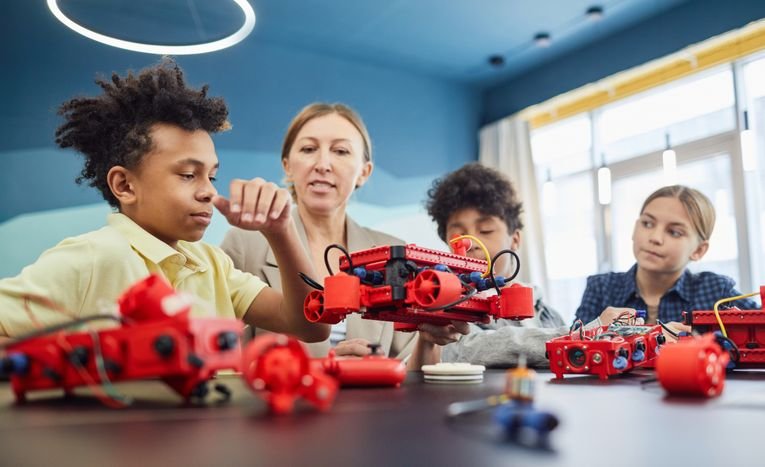
STEM robotics kits are educational robot building sets, ranging from simple screen free toys for young children to programmable microcontroller kits for teenagers, designed to teach science, technology, engineering, and mathematics concepts through hands on building and coding. They typically combine physical construction, using motors, sensors, and simple mechanical parts, with a coding element that ranges from drag and drop block programming to full text based languages such as Python. For UK parents and schools, the right kit depends heavily on the child’s age and existing experience, since a kit pitched too far above or below a child’s level quickly loses their interest.
Robotics has become a core part of the UK computing curriculum and a popular after school activity, driven by growing demand for STEM skills and the increasing affordability of kits that were previously aimed mainly at schools and clubs. This guide covers the main categories of robotics kit by age group, what to look for when choosing one, and how to get genuine educational value from robotics at home rather than a kit that is used once and abandoned.
Robotics Kits by Age Group
| Age Range | Kit Type | Skills Introduced |
|---|---|---|
| 4 to 7 | Screen free coding robots, such as directional command based toys | Sequencing, basic cause and effect, early logical thinking |
| 7 to 11 | Block coding robot kits with app based programming | Block based coding, loops, sensors, simple building |
| 11 to 14 | Microcontroller kits (such as micro:bit based builds) | Basic electronics, introductory text and block coding, circuits |
| 14+ | Raspberry Pi and single board computer robotics kits | Python programming, computer vision, more advanced electronics |
Starting a child with a kit slightly below their expected level, rather than above it, generally produces better long term engagement, since early wins with a robotics kit build the confidence needed to move on to more advanced building and coding challenges.
What to Look for in a Robotics Kit
- Reusability: Kits built from reusable components that can be reconfigured into new projects offer far more long term value than single build kits that only ever form one robot.
- Coding pathway: Look for a kit with a clear progression, ideally moving from block based coding toward text based languages such as Python as the child’s confidence grows.
- Community and lesson support: Kits with an active online community, official lesson plans, or school curriculum alignment tend to keep children engaged for longer than a kit with no supporting material.
- Build complexity versus frustration: A kit that is too fiddly for small hands, or too simple to hold an older child’s interest, is one of the most common reasons a robotics kit ends up unused.
- Battery and power requirements: Rechargeable battery packs are generally better value and more environmentally sensible than kits requiring frequent disposable battery replacement.
Robotics in UK Schools
Robotics and physical computing now form a recognised part of the UK computing curriculum, and many schools use micro:bit devices, distributed free to Year 7 pupils in an earlier national rollout, as an entry point into coding and electronics before moving on to more advanced Raspberry Pi based projects at GCSE level. Extracurricular robotics clubs and competitions, including national and regional First Lego League style events, give pupils a structured, team based route into more advanced robotics beyond the standard curriculum.
Getting Genuine Educational Value at Home
- Let the child struggle with a problem for a reasonable period before stepping in, since working through a stuck point independently is where most of the learning actually happens.
- Move beyond the kit’s included instructions once the first build is complete, encouraging the child to design their own variation using the same parts.
- Pair the robotics kit with a simple, achievable coding goal each session rather than an open ended “build something” instruction, which many children find harder to start.
- Revisit the kit periodically with slightly more advanced challenges rather than treating the first successful build as the end point.
- Where possible, connect home robotics activity to what the child is doing in school computing lessons, since reinforcing the same concepts in two contexts noticeably improves retention.
Expert Insight
Teachers who run robotics clubs consistently report that the biggest factor in a child sticking with robotics long term is not the sophistication of the kit itself, but whether the child gets to make creative decisions rather than simply following a fixed set of build instructions. A basic kit used to build several different, child led projects tends to sustain interest far better than an advanced kit used once to complete a single predetermined build.
Frequently Asked Questions
What age should a child start learning robotics?
Screen free robotics toys are suitable from around age four, with structured coding based kits generally becoming appropriate from around age seven upwards, depending on the individual child’s interest and dexterity.
Do robotics kits require prior coding experience?
No. Most kits are designed for complete beginners and introduce coding gradually through block based programming before any text based coding is required.
Are robotics kits worth the cost for home use?
Reusable, reconfigurable kits generally offer better long term value than single build kits, since they can support years of different projects rather than being outgrown after one build.
What is the difference between micro:bit and Raspberry Pi based kits?
A micro:bit is a smaller, simpler microcontroller aimed at introductory electronics and coding, commonly used in UK primary and early secondary schools, while a Raspberry Pi is a more powerful single board computer suited to more advanced projects including computer vision and more complex robotics builds.
Can robotics kits help with school computing coursework?
Yes, particularly kits based on micro:bit or Raspberry Pi, since these closely mirror the tools used in UK secondary school computing curriculums and GCSE computer science coursework.
Final Thoughts
STEM robotics kits give children a genuinely practical route into coding and engineering concepts that can be difficult to teach through screens alone, provided the kit is matched to the child’s age and allowed to evolve into more open ended, creative projects over time. For families exploring wider home technology and automation, our guide to robot lawn mowers shows how the same core robotics principles, sensors, navigation, and automated decision making, apply well beyond the classroom. For our full coverage of robotics in the UK, see the robotics hub.